
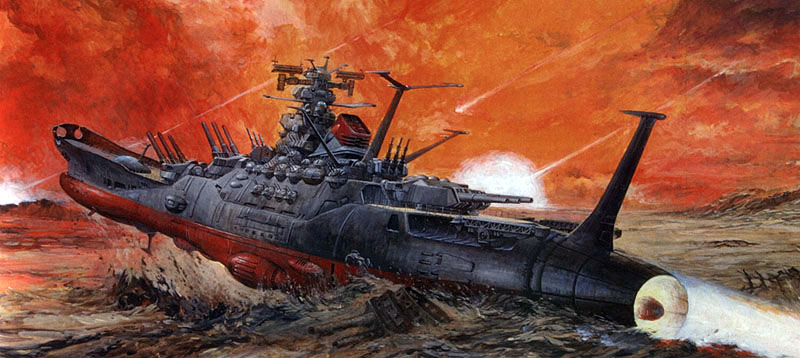
Space Battleship Yamato (Uchuu Senkan Yamato) was created by Leiji Matsumoto as the first anime space opera premiering in 1974. It was monumentally influential by pioneering a serious tone and complex storytelling which would later influence Captain Harlock, Macross and Mobile Suit Gundam to name a few.
If you want to start watching Space Battleship Yamato you’ll want to decide if you want to start with the classic series, or the more 2012 remake. Both are good starting points, we’ll cover them both in detail and then finish with a summary. Click here to jump directly to the summary.
Classic Yamato
It is the year 2199. In the distance future Earth has lost the space war and the citizens now live underground under constant interplanetary bombardment. Unfortunately, even beneath the earth’s surface lethal radiation has been seeping in and soon the human race will face extinction. With time running out, the people of Earth are contacted by a distant civilization and a alien woman named Starsha from the planet Iscandar who promised to give them a device that will save the Earth.

Captain Okita, survivor of the previous space war, takes the Space Battleship near identical in exterior appearance to the famous WW2 battleship Yamato but equipped with a wave motion engine given to them by Starsha, this in turn will allow them to warp and travel faster than light speed in order to reach Ischander and return to Earth before it’s too late.
Each episode ends with a countdown of how many days are left before the human race goes extinct. The urgency delivered at the end of each episode, the iconography of using the famous warship Yamato, and being one of the first anime to take on a deep and serious plotline make Space Battleship Yamato an instant hit with the Japanese population in the 1970s. It inspired many other works that came after it including Mobile Suit Gundam and Macross, and it’s opening series is given a near scene for scene homage in Hideaki Anno’s Nadia of the Blue Sea.
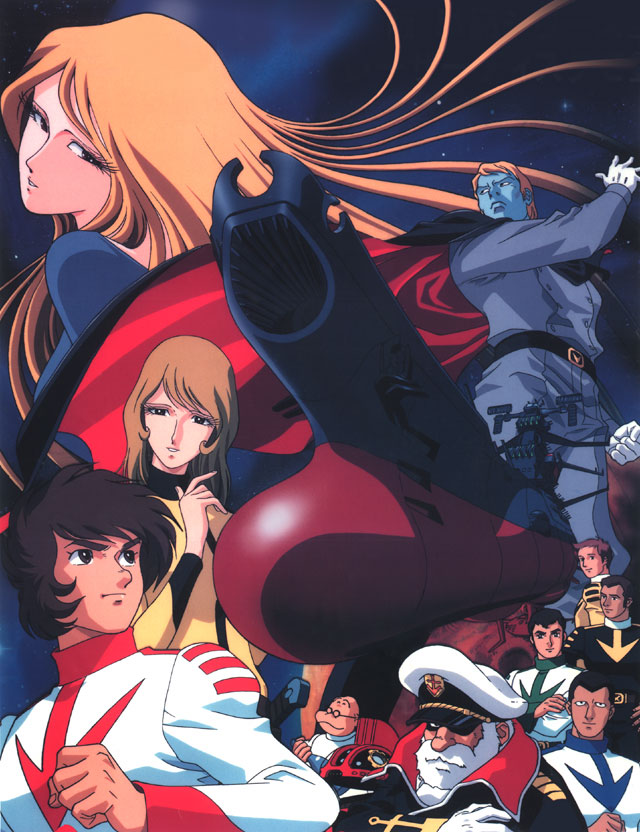
The main antagonist of Yamato I is Dessler (or Desler depending on your translation) leader of the Garmilas Empire (also called Galman Empire in older translations) a race of aliens who resemble humans in nearly all other capacities save for their blue skin. Dessler is a fairly one note, very obviously evil villain; and while very simple on the surface, some of the most memorable and shocking moments of Yamato and it’s sequels are when Dessler acts out of character, although perhaps, out of expectations is the better term as we learn more of his own personal character and code during each of these moments.
Space Battleship Yamato is a great show, beloved by many mecha fans in Japan as well as in the west where it was localized as “Star Blazers”. If you’re curious about the western localization you can read more on Tim Eldred’s site, he’s also got great reviews for each series: https://ourstarblazers.com/vault/series-1-the-quest-for-iscandar/
The TV show is 26 episodes and also has a nicely animated compilation movie. The show tends to feel longer than 26 episodes, partly due to the storytelling of the 70s but also because the show does a very good job of setting up slow burn character development, and interpersonal dynamics. Compared to a lot of modern series, the pacing and focus on a few core group of characters was actually a bit relaxing and made for classic Yamato a really nice watch once or twice per evening and a few more on a Sunday afternoon.

The success of the compilation movie led to the second movie Farewell to Space Battleship Yamato (Saraba Uchū Senkan Yamato Ai no Senshitachi or Saraba Yamato for short). This movie was very popular with fans and led to a letter campaign which revived the series, since the movie gave a very final ending with no room to continue. The movie’s animation would then go on to become Yamato II (often called Yamato Season 2 by fans) for another 26 episodes.
The Antagonist is the Great Comet Empire (Gatlantis) and Dessler (Garmilas empire) returns working with the Great Comet Empire to destroy the Yamato, as well as experiencing more significant character arcs. While fleshing out your antagonist is fairly common in modern anime, it was fairly avante-garde while Yamato was airing.
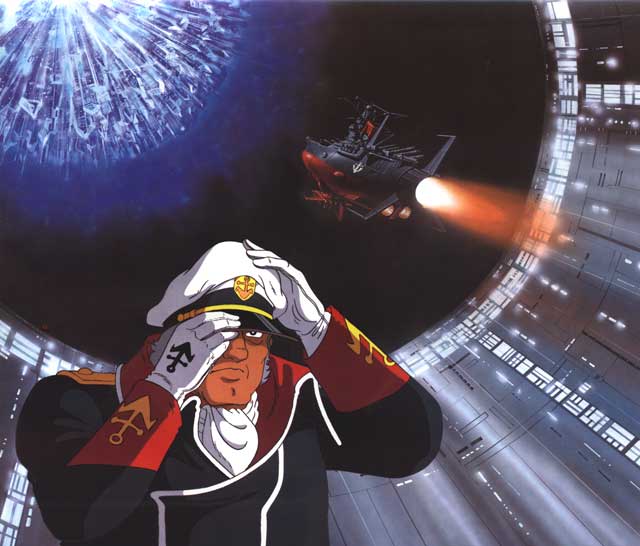
Classic Yamato would then be followed by two movies, the shows Kodai’s growth from tactical officer into a ship captain as well as a slow simmering relationship with Yuki. Later there’s a third season of Yamato, which is a bit of a bore in my opinion, then the Final Yamato movie. There’s also Yamato Resurrection which was made 20 years later after some rights disputes.
Watch order for the Yamato (Classic)
- Watch Yamato (TV 26eps)
- Watch Yamato II (TV 26eps).
- Watch Yamato: A New Journey (Movie)
- Watch Be Forever Yamato (Movie)
- Watch Yamato III (TV 26eps)
- Watch Final Yamato (Movie)
- Bonus option: Yamato Resurrection
Author’s note
When it comes to classic Yamato I found the first two TV series and Be Forever Yamato to be the best. A New Journey is good for 95% of the runtime, but the ending is so unbelievably dumb that I wish I had simply skipped it. Yamato III isn’t bad but isn’t exciting either. Final is hit or miss with fans depending on whether you are onboard with the twist or not.

Modern Yamato
2012 marks the debut of modern Yamato, which hereafter will be referred to Yamato 2199 (or Starblazers 2199 for it’s global release). Yamato2199 brings back all your favorite characters with updated designs, animation and production value expected of the 2010s, it is animated by Studio Xebec, who at the time was under Production IG although the studio would later be acquired by Sunrise.
Yamato 2199 is a retelling of the original Yamato story, while it also has 26 episodes, the story feels significantly more condensed. Part of this could be considered the elimination of ‘filler’ episodes, another bigger part of it, is the vastly expanded cast and new plotlines introduced, which is modern Yamato’s biggest strength and weakness.
One of the weaknesses of classic Yamato is that because it focuses only on a few characters (Kodai, Shima, Yuki and Sanada/Okita) they essentially are involved in every single issue or adventure on the show, and there are times where it will feel impractical to have your bridge officers doing everything, especially ground missions while the ship itself is still in danger. Still this is a pretty common scifi trope so it’s not unexpected. That said, this is also one of classic Yamato’s strengths, by having only a few characters you really get to know them, and root for them and so when a dramatic event happens later and leads to either a temporary or permanent loss of the character it has a tremendous amount of impact on the viewer.
I bring this up because in the remake, the additional characters will by necessity take away from the enormous amount of screentime the principle 4 characters of the original had. There is only so much screentime to go around, so if you think of a pie chart and generously give a 25% slice of pie each to Kodai, Shima, Yuki and Sanada/Okita taking the last quarter; if we were then to add 8 additional characters, even if their screentime is small each of those slices of pie is going to be noticeably smaller. But that’s not necessarily a bad thing. Many storytellers can incorporate a large amount of memorable characters in that runtime and weave them in to the story to enhance the story. While many new characteres either enhance the story, provide a nice comic relief, or make the ship feel a lot larger and more populated than the original, there were definitely times where I found myself thinking “Y’know, I haven’t seen Shima in the spotlight for a while”.
The biggest flaw in modern Yamato, is a flaw that many of other remakes and reboots share, where a very memorable and iconic scene of the original is transplanted into the modern retelling but the new storytelling did not successfully setup the conflict or resolution making the scene feel either out of place or logically inconsistent or hard to believe with the events going on.
The retelling did an adequate job of trying to adapt some of those famous scenes that were pivotal to the original, and while the voice actors did a great job conveying the emotion, personally I felt it fell a bit flat and certainly inferior to the original. I could tell the scene was being included, solely because it happened in the original, but the buildup to the scene was absent. A big part of that is the lack of slow-burn buildup of those 4 principle characters and the way their relationships deepened over the show.
***SPOILERS***
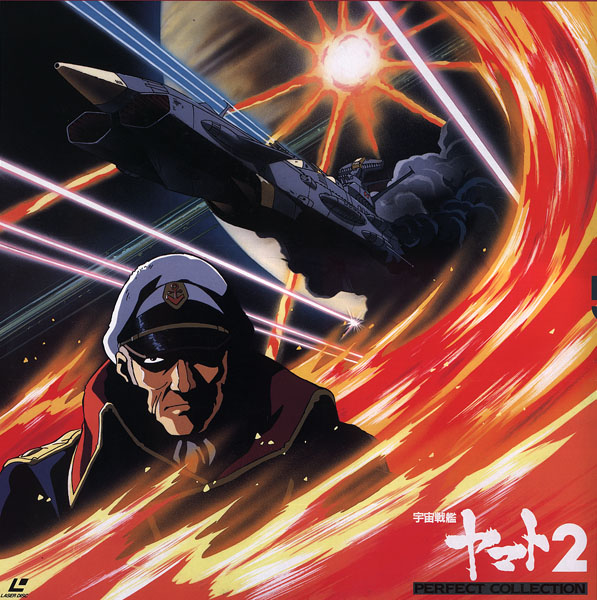
Dessler’s portrayal I think is notorious for being a ‘missed opportunity’ in fan discussions. The OG Dessler, who you could describe simply as ‘monotone evil’ in the original has a much more nuanced and compelling portrayal in the remake. A ruthlessly evil character, showing mercy out of nowhere is a shocking and unexpected development, but by portraying him in a gentler light with ulterior, perhaps noble intentions, from the get-go, you are also directly undercutting his famous merciful scenes. His mercy becomes less of a stunning turnabout, and more of a “well that’s to be expected” moment. While generally one-note black and white morality characters are usually inferior than a character with depth and understandable motivations, in this case the simplicity of the one-note bad guy actually greatly enhanced the narrative instead (and led the way for future development). So I would say the remake’s Dessler is one of the rare cases where adding nuance to a villain, actually made them inferior to their one dimensional original version. Hijikata’s 2199 version has a similar issue with being one note but it’s a minor gripe in comparison.
***SPOILERS***
Both in 2199 and 2202 they had several opportunities to make it crystal clear to the viewer that there are only a few habitable planets in the galaxy, which would track nicely with Dessler’s backstory reveal in 2202 as to why they were meteor bombing Earth. But while the writers of 2202 are happy to beat you over the head with every narrative truncheon they can come up with in their unceasing melodrama, they somehow forgot to do it with this one.

Yamato also had a sequel movie with the same director (Izubuchi) set between the end of the show and the start of 2202 (Yamato season 2). It’s a good movie, but, alas adds even more characters which is one of 2199’s weak points. It’s worth a watch.

Yamato season 2 is remade as Yamato 2202, released in 2017 five years after Yamato 2199. The sequel keeps the same art style and same characters.
Well, I should recant part of that, many of the new characters introduced in 2199 are sidelined almost immediately. Whether that’s in response to fan-feedback or a change in priorities of the new Director/Writer team is all speculation at this point. That said, after the initial sidelining of characters some expected this one to hew close to the classic Yamato 2202 and focus on the 4 core characters instead. Well, it does somewhat; it also spends an inordinate amount of time on the enemy, the gatlantis empire, for better or for worse. The melodrama becomes wearisome to say the least. There are also a few twists, just as 2199 had, but they are not as impactful and a few are headscratchers.
Author’s note:
Keep in mind that while Yamato 2199 was a very well received remake by fans and new viewers, the sequel Yamato 2202 tended to be quite divisive with fans. I will chalk up most of that to the change in director from Izubuchi (Director of Patlabor & Raxephon, famous mechanical designs for Gundam 0080 and CCA) to Nobuyashi Habara (Fafner). As the rumors go after Izubuchi left the lead writer, Harutoshi Fukui (who is a a love or hate kind of writer who wrote Gundam Unicorn…but also Narrative) began to have a lot more sway over the project which appears evident to me as the sequels continued.
Overall, the 2202 remake wants to take on a much darker tone than the original (and 2199) and I don’t think it succeeds. In my estimation it seems to completely miss what made Yamato special in the first place, the insurmountable human spirit, not the wallowing in doom and gloom that we see on screen for most of the runtime. 2199 is an excellent remake on par with the original, but 2202 fails to live up to the simple and straightforward storytelling from 40 years ago.
Parental Advisory
One additional item to note, for parents who like to watch shows with their kids, the OG Yamato was aimed at a very broad age range including children, the 2199 Remake is the same albeit with a large amount of added fanservice.
Yamato 2202 on the other hand, includes a number of darker themes such as suicide bombers, and several graphic / gory scenes. There is one graphic scene in particular in the final arc, that is a flashback used over and over again as a narrative truncheon to beat you over the head. It is rather unnecessary (not to mention repeated ad nauseum) and in my opinion the delivery of the message remains hollow with or without that scene. As a result, the scene doesn’t add much, will be repeated several times and is not suitable for young children.

Yamato A New Voyage is remade as Yamato 2205 (2 films).
Be Forever Yamato 3199 – Is currently being released and will remix elements of Be Forever Yamato and Yamato Season III.
Summary of OG Yamato vs Yamato 2199
While it recreates many of the important story beats of the original Yamato there are enough new ideas, side characters, plot lines and twists that many parts of the show will feel new to classic fans. Here’s a quick summary of the key differences between the two.
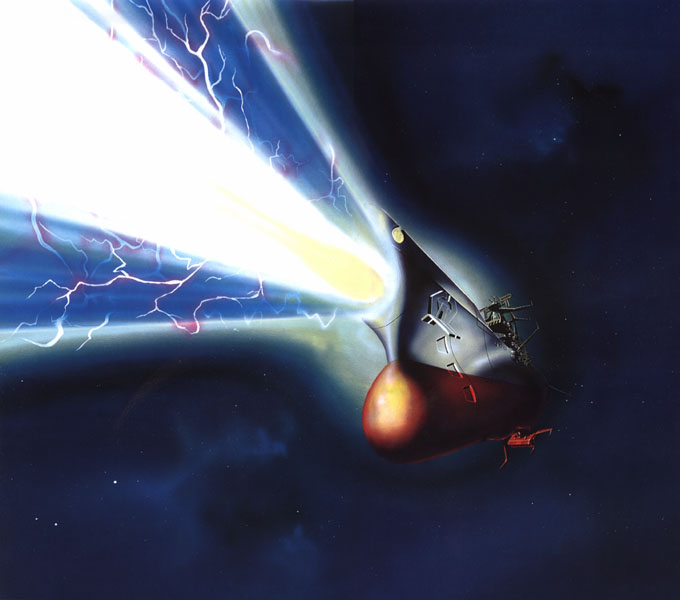
Storytelling
The original series tends to have the edge when it comes to dramatic storytelling, while both OG and remake rely on some tropes and directing tricks to build tension, the OG series tends to have the edge when it comes to dramatic storytelling and tone. The OG series does move pretty slow compared to the remake.
The remake, in order to keep things fresh for longtime fans has several twists or deviations from the orignial script. Some of the twists are good but some fall flat.
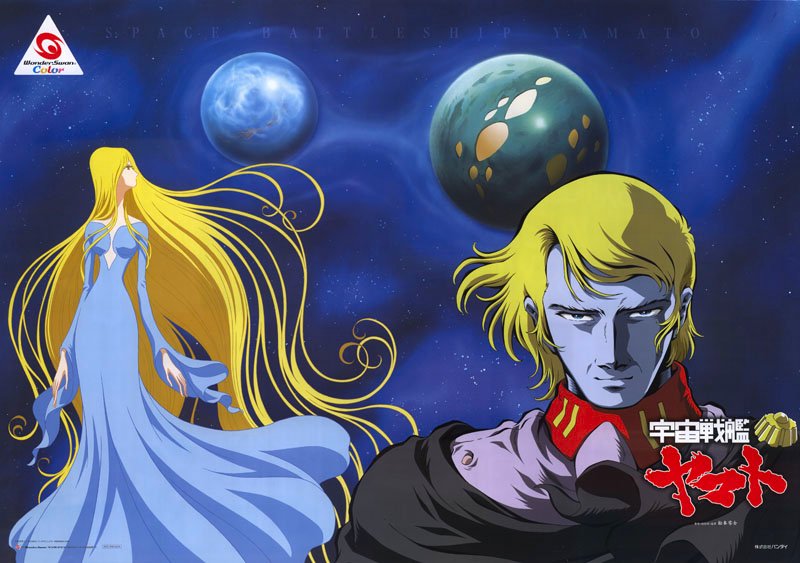
Artwork
The artwork in the original series is obviously dated, but standard for the time period it released. Character art has been updated in the remake and is overall good with high production values. Unfortunately I do think the modern style did an extremely poor job of capturing the ephemeral and alien beauty of Starsha seen in the original classic which hewed very close to Leiji Matsumoto’s design.
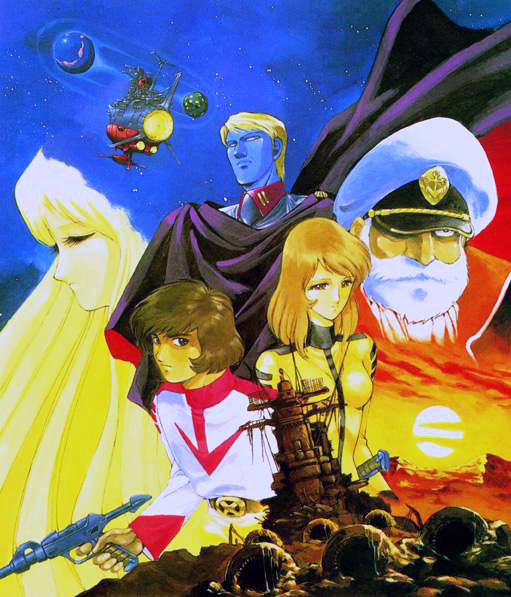
Mecha
The remake uses CGI almost always for it’s battleships and fighters, while it looked pretty good in the 2010s it is very dated now. One of the permanent advantages of hand-drawn is that it is timeline, and the mecha designs and animation done by Studio Nue (of Macross fame) for Yamato still hold up today. Another downside in the modern sequels is that the director’s follow the cardinal CGI sin of “More is better” so the amount of weightless CGI silhouettes on screen will rapidly multiply and overall ironically detract from the seriousness of conflicts and sacrifices made. Generally the classic series does a better job of showcasing the weight of space conflicts with a “Less is more” approach.
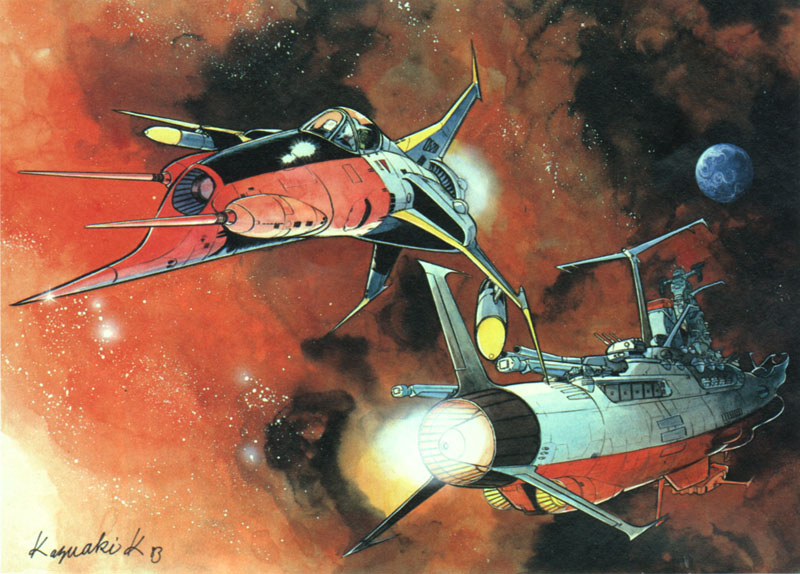
Returning Characters
Overall the modern remake doesn’t really have a lot of screentime for Shima or Sanada. Shima gets used in a new plot, that is setup and fizzles out almost immediately which is a bit of a wasted potential. For Sanada, the suicide mission that establishes the friendship between Kodai and Sanada is missing and quite disappointing, although the respect is recreated in the remake (especially the 2199 interlude move Odyssey of the Celestial Ark). The relationship dynamic between Kodai and Yuki and very different, which is neither a plus or a minus, but I personally prefer the originals.
New Characters
I may be a minority in this one, but I actually really enjoyed the additional characters added to Yamato, but I also think they could have integrated some of them better. There are a lot of good new characters, but also a lot of mediocre new characters. While the size of the cast is appropriate for a space battleship, occasionally the storytellers fumble it and the added characters are more of a throwaway rather than a useful addition to the narrative.

Where to Start
For this author in particular I had watched classic Yamato first and then modern Yamato later but all within the course of a year. Having seen both, I appreciate the modernization but there are several times where I found myself thinking “the original series showcased this moment better.”
Yamato is very lucky in that both the original series and the 2199 remake are very competently done, so you can watch either series with the satisfaction of knowing you’re going to get a good and complete story either way. Whichever one you decide to watch is up to personal preference, but I do highly recommend watching both if you can spare the time.
As always, if you have infinite time on your hands, then the ‘correct’ way to get into a franchise is to watch things in production order starting with the first series produced and watching everything in the order it came out.
If you’re like us, and time is a limited luxury between family, work, hobbies and a social life here’s a recommendation for what to watch. If you do plan on watching both series eventually, I think it’s better to watch the OG series first.
Watch order for the Classic Yamato
- Watch Yamato (TV 26eps)
- Watch Yamato II (TV 26eps).
- Watch Yamato: A New Journey (Movie)
- Watch Be Forever Yamato (Movie)
- Watch Yamato III (TV 26eps)
- Watch Final Yamato (Movie)
- Bonus option: Yamato Resurrection
Author Notes
- The Yamato II movie came first and a fan letter writing campaign caused the 2nd season TV show to be made with a very different ending.
- For a New Journey, consider skipping the last 20 minutes.
- If you skip Yamato III you aren’t really missing much.
- Final Yamato is enjoyable, but the twist is a bit too much for some people.
- Yamato Resurrection has a very different art style that I don’t care for.
Watch order for the Modern Yamato
- Watch Yamato 2199 (TV 26eps)
- Watch Yamato 2199 Odyssey of the Celestial Ark (Movie)
- Watch Yamato 2202 (TV 26eps).
- Watch Yamato 2205: A New Journey (2 Movies)
- Watch Be Forever Yamato: Rebel 3199 (Part 1 Released)
Author Notes:
- The 2199 Movie is good but you’re not missing out by skipping it.
- Yamato 2202 in general is not suitable for young children.
- I don’t personally enjoy 2202 but others do, so give it a shot and decide for yourself.
- Whether or not you enjoy 2202 will likely determine if you will enjoy 2205 / 3199.
If you’re curious about Leiji Matsumoto’s other popular works such as Captain Harlock or Galaxy Express 999 read this post here. You can also use the where to start tag for other mecha anime series..
 MechaStellar
One thought on “Where to Start Space Battleship Yamato”