Playtest Report – Jaburo Drop

Exif_JPEG_422

Playtest Report

<Meant to post this one two weeks ago>

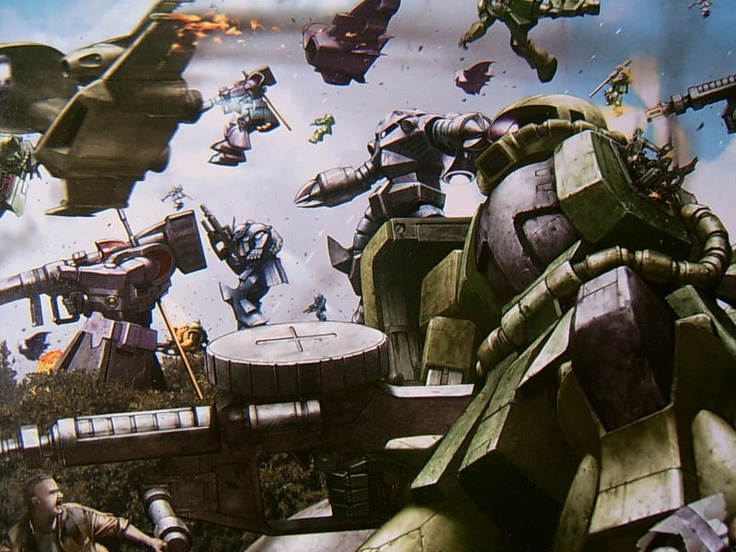
We haven’t played a large game in a while so we broke out some forest and aquatic terrain and decided to try reenacting the Jaburo Drop from 0079.  We did the scenario three times, each time increasing the size of the army to see how well it would scale; it also gave us a chance to try some of the very minor rules tweaks we were discussing.  The scenario would be a pseudo two-mission campaign with the twist being the second mission (underground) kicks off while the first mission (top side) is ongoing.  The sooner the 1st mission is completed the sooner reinforcements can arrive.

Continue reading “Playtest Report – Jaburo Drop”

MechaStellar – Weapons Design

Full_Armor_Gundam_Thunderbolt-ova

When it comes to weapons we had the following design goals.

  1.  To the extent possible minimize variations
  2. Variations between weapons should be distinct
  3. Maximize re-usability of weapons between units

To elaborate a bit further on these, for #1 when looking at a list of weapons you don’t want to see 5 versions of a machine gun, or 4 versions of a beam rifle, each with their own nuance.

Continue reading “MechaStellar – Weapons Design”

MechaStellar: Update Combat Roles

Gelgoog cannon

Our suit roster is an excel sheet with a number of formulas where if you type in the Suit’s Frame Level and Performance level it will auto-populate all of it’s combat stats.  So while we were updating the attack and evade cells to essentially flip flop (Evade now uses the d20, Attack is now a static number) we decided to reevaluate a few of the bonuses each of the combat roles were giving.

Combat Roles Refresher

Each suit gets to choose one of four combat roles that define how they play.

  1. Gunner – Ranged focused
  2. Battler – Melee focused
  3. Versatile – Mix of Ranged and Melee
  4. Hi-Mobility – Evasion focused

Looking at the gundam universe for example the most common role will be Versatile as most suits fielded are general purpose.  Below are some examples:

  1. Gunner – GM Sniper, Gabthley, Gundam Leopard
  2. Battler – Gouf, Efreet, Sturm Galluss, Deathscythe
  3. Versatile – Most types of Gundam, GM, Zaku and successors
  4. Hi-Mobility – Dom, Kampfer, Hambrabi, Rick Dias, Sinanju

If you look at the Battletech / Mechwarrior universe you’ll see a lot more Gunners dominating the roster.  Heavy duty battlemechs with ablative armor are classified as “Titans” in mechastellar.  They’re rules are a bit different than mobile suits, in a general sense they have more HP and AP but less Evade.

  1. Gunner – Blackjack, Thunderbolt, Catapault, Zeus, Jupiter
  2. Battler – Kodiak, Violator
  3. Versatile – Shadowhawk, Centurion, Battlemaster
  4. Hi-Mobility – Griffin, Spider

Now then when it comes to combat roles here’s what we previously posted.  Note, we’ve adjusted some naming conventions, instead of Ranged Attack and Melee attack we’ve renamed them to Shooting and Melee.

  • Gunner
    • Shooting +5
    • Action Points +4
    • Evade -3
  • Battler
    • Melee +4
    • Move +4
    • Evade +1
  • Versatile
    • Shooting +3
    • Melee +2
    • Move +3
    • Action Points +2
  • Hi-Mobility
    • Move +6
    • Evade +3
    • Melee +1
    • HP-100

MechaStellar: Design Update – Melee

Gelgoog Naginata

While we were playtesting the streamlined but ultimately boring evasion system we also had a chance to play around with melee a bit.  Not the mechanic per se just the values.  In the original rules we had melee as a clash between two opponents, each rolls a d20 and adds their value, with the attacker getting a free reroll.

Continue reading “MechaStellar: Design Update – Melee”

MechaStellar: Design Update – Evade

Gelgoog d

Aloha everyone!  We’ve spent the past few months playtesting a different type of attack and evade mechanic for Mechastellar and today we’ll talk about the results.

First up the mechanic.  We had the pleasant experience doing a several large scale playtest games over the holidays in Nov/Dec to try out the VER 2.0 ruleset and it was quite successful.  We had a chance to try high level suits vs army of grunts, prototype vs prototype match-ups, melee master faceoffs (Death Scythe Vs Master Gundam), team games with objectives and multiplayer free-for-alls.

Continue reading “MechaStellar: Design Update – Evade”

MechaStellar: Design Update


NemoBased on some feedback from playtesting we’ve been testing out a few potential overhauls to the base system.  One of them that has been working very well has been to adjust Action Points for units.  This has worked well enough so far we are confident bringing it back into the core ruleset.  Here’s how it works.

CURRENT RULES:

Gunner type units have +2 AP.  Useful for Snipers to fire powerful weapons despite being a low frame level, also useful for artillery units to continue shelling with IDF.

ADJUSTED RULES:

Gunner type units have +4 AP.

Versatile type units have +2 AP.

This provides additional action points for most units in the game.  While it seems like a minor change it has quite a bit of impact system wide,.  For example, your Zaku II can make 4 shots with a Machine gun instead of 2.  Feedback from playtesters was very positive on this front since it allows them to field less units while maintaining threatening firepower.

The bonus AP came as we were testing a prototype change to ATK and EVADE rules.  It was discovered that grunt units like the GM, Nemo, and Barzam weren’t able to put out enough shots to threaten a high performing machine like the Hambrabi or Hyaku Shiki.  Giving all these Versatile suits +2 AP, and splitting off Beam Rifle (3AP) into a 2AP and 3AP (Hi-Power) variant was enough to allow these grunts to threaten high performing suits again.

We’re incorporating these changes into the rules document and hope to have a VER 1.0 ready to be posted in February.  Till next time!

MechaStellar: Turn-by-Turn Ex of Play

TBT1

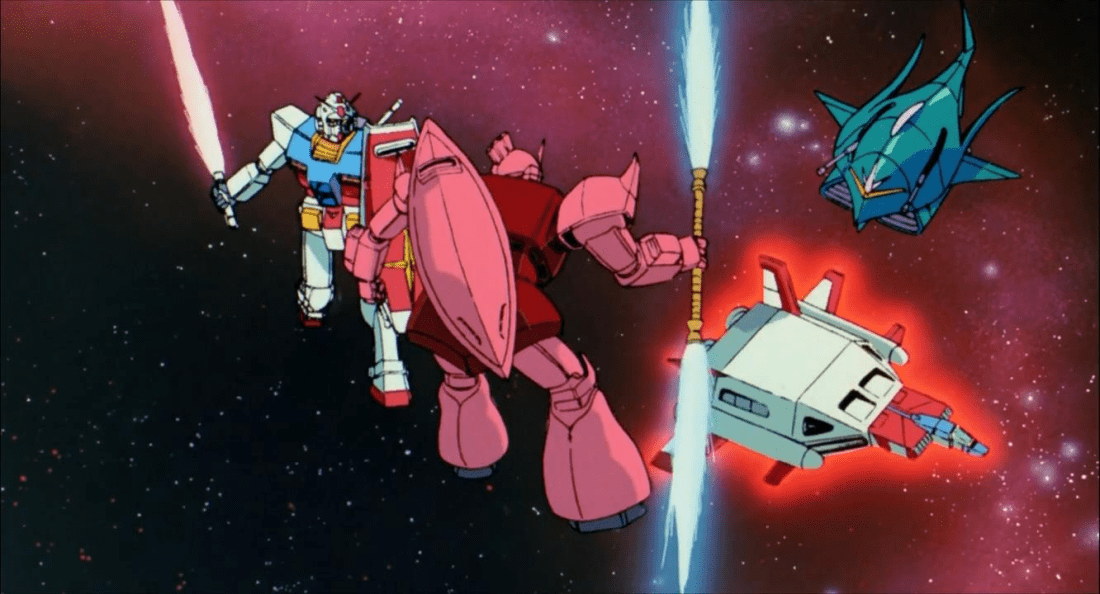
In this post we’ll do a turn by turn post for a small skirmish between the RX 78-2 Gundam piloted by Amuro in his early days and platoon of Zaku IIs led by the infamous Gouf Ramba Ral.  Models used are the 1/400 scale Gundam figures you can get from vending machines in years past.

Gundam  Frame 4  Performance 2  Pilot 2 HP 1200  ARM 3+ (Super Armor & Shield)  AP:9  ATK+5  EVADE 16.

bbFrame 2  Performance 3  Pilot 7  HP 400  ARM 6+ (Shield)  AP:4  RATK +3  MATK+10  EVADE 14

2x Zaku II (Machine Gun)  Frame 1  Performance 2  Pilot 1  HP 300 ARM 7+ (Melee shield)  AP:2  ATK +5  EVADE 14

2x Zaku II (180mm Cannon)  Frame 1  Performance 2  Pilot 0  HP 300 ARM 7+ (Melee shield)  AP:2  ATK +5  EVADE 14

The Gundam has sensors range of 12″ so the Zeonic enemy has to stay outside of that when deploying. The area is rather small so their forces are spread to the edges. The Zeon forces have more units so they go first.

Continue reading “MechaStellar: Turn-by-Turn Ex of Play”

MechaStellar: Tactical Advantage

Gouf Custom

It MechaStellar we wanted to have a few different options to pursue that would give you a tactical advantage over your opponent.  We started with five different categories each with a different benefit, but after significant play testing we opted to consolidate down to three categories.  Next we gave each one the same effect, to make it easier to remember on the fly.

The three tactical advantages are as follows:  Blindside!  High Ground Advantage and Point Blank Shot.

The benefits of such have gone through many revisions, the most recent one involved rerolls, but after stacking 3 rerolls on a suit with +2 ATK we soon realized it got a little silly.  Here is the current incarnation of the rules.

Tactical Advantage

  • Each conditions provides +2 ATK, +1 PEN & costs +1 Cost for Skill Defense
    • Remember: Melee and AOE attacks cost +1 for Skill Defense
  • NOTE: These advantages do not apply when using Indirect Fire.

Here are the restrictions for each.

  • Blindside! Moving behind your target’s 180 degree facing arc
    • NOTE: To Blindside the unit when activated must already be behind their target’s 180 degree arc or LOS cover. You cannot walk past an opponent who has LOS and blindside.
    • You can only Blindside the first melee attack. The Defender spins around after that.
  • High Ground! The feet of your figure must be higher than the enemies head.
    • NOTE: Jumping does not enable High Ground, they must be standing on terrain
    • NOTE: High Ground does not apply in space battles
  • Point Blank! Attack with a Ranged (not Melee) weapon within 6”


The advantages are quite significant.  The Attack bonus allows for suits with low ATK to have a better chance to hit suits with higher EVADE.  PEN means non-beam weapons now get a chance to punch through heavily armored suits, especially if you can stack advantages.  Ex: Shooting a Machine Gun point blank and blindsiding gives each shot +2 PEN.  Lastly, +1 Skill cost means that your Ace pilots should be going for flashy moves like going for high terrain or boosting around the cover for a sneak attack, since many grunts do not have more than 1 or 2 skill, that +1 skill cost means they won’t be able to auto-dodge an attack.

Tactical Advantage is a player favorite but we’re still fine tuning it.  Now that we’ve covered all the main rules we’ll do a turn-by-turn match in the next post.

MechaStellar: Unit Points Cost

Gundam and TriStars

We discussed in previous posts that Frame is the biggest driver in a units cost to field, and in our last post we talked about how Pilot skill has a variable cost depending on whether you are piloting the average grunt or an extreme prototype.  In this post we’ll go over the math on calculating a units cost.  Worry not!  The unit excel sheet autocalculates points based off of your inputted Frame, Performance and Pilot level so you don’t need to do anything by hand.

We’ll start with Frame Level.  The cost is Frame Level squared times 5,  or 5x (Frame LVL)^2 .

Level 1 Frame = 1 x 1 x 5 = 5 points

Level 2 Frame = 2 x 2 x 5 = 20 points

Level 3 Frame = 3 x 3 x 5 = 45 points

Level 4 Frame = 4 x 4 x 5 = 80 points

Level 5 Frame = 5 x 5 x 5 = 125 points

We decided early on Frame Level would be a big points cost and decided on an exponential growth function.  Since Frame controls HP, AP, and Armor Saves, each one is considerably good and by the time you reach Frame 4 and 5 you are very, very sturdy compared to your peers and the cost reflects that.

For Performance and Pilot Skill we initially started with something very simple.  Performance was 2 points per level and Pilot Skill was 3 points per Level.  Now as mentioned at the end of last post, pilot skill lets grunt suits keep up with top of the line suits, now if you put an ace pilot in a powerful machine pilot skill becomes even better.

Likewise for Performance, a Frame 5 Performance 0 Machine may have all the firepower but terrible targeting.  But a Frame 5 Performance 10 machine will be unstoppable.  As a result we decided the formula we need to change at higher Frame Levels.  We made the cutoff at Frame Level 3, since Frame 1 & 2 are where we keep all the grunt suits, and 3 is the transition between grunt and unstoppable prototype.

Here is the formula for Performance.  2.5 points per level for Frames 1 & 2.  5 points per level for Frame 3, 4 & 5.

Pilot skill is similar.  2.5 points per level for Frames 1 & 2.  5 points per level for Frames 3, 4 & 5.  After summing points between pilot and skill, round down, so cost of 22.5 becomes 22.

Additionally, if you cross the threshold into Ace Pilot (6+) there is a 10 point premium to pay.  The premium is there to help with the Pilot skill ability to auto-hit against a lower level pilot.  Putting the premium in there means not every unit fielded will be an ace, and those that are will be nearly immune to the effect.

You may be wondering why we didn’t use a linear formula, making performance or skill cost more at each Frame level? i.e. Frame 5 has a higher performance cost than Frame 4.

There are two reasons for that.  One is simplicity, you don’t want to have too complicated a formula, especially if you are going by hand.  Two, while a Frame 5 is more powerful than Frame 4 and 3, in playtesting we found that there isn’t enough to justify a bigger points cost for Performance.  They already have a high base due to the Frame cost (45, 80 and 125 respectively) that adding on scaling performance made it more egregious and people less likely to field high frame suits.  Since many iconic suits are Frame 4, we wanted to avoid that outcome.
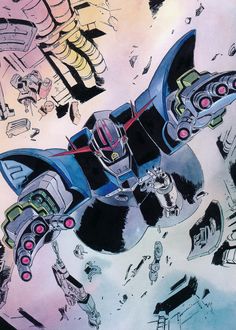
Zeong

Lastly there is an EQ Slot option for low production cost.  This is to represent some mass-produced models that were pretty barebones.  It’s also great to take when you know the model should be a high Frame LVL but you don’t want to justify the cost to field such a slow moving behemoth.  This EQ slot is only available at Frame 2+, and it may not exceed your Frame level.  E.g. Frame 3 can have LVL 2 Low Production cost.  At Frame 2 it reduces points by 5, at 3+ it reduces points by 10.

Now time for some examples.

Early GM Mass Produced – Frame 1, Performance 0, Pilot 0 = 5 + 0 + 0 = 5 points

GM Ground Type – Frame 1, Performance 1, Pilot 1 = 5 + 2 + 3 = 10 points

Zaku II Veteran – Frame 1, Performance 2, Pilot 2 = 5 + 4 + 6 = 15 points

Dom – Frame 2, Performance 3, Pilot 2 = 20 + 9 + 6 = 35 points

Gouf Custom – Frame 2, Performance 5, Pilot 10 = 20 + 10 + 30 + 10 Ace Premium = 70 points

Zeong (Char) – Frame 4, Performance 4, Pilot 8 = 80 + 20 + 40 + 10 Ace Premium = 150 points

Gundam (Magnetic Coating) – Frame 4, Performance 4, Pilot 8 = 80 + 20 + 40 + 10 Ace Premium = 150 points

Gundam (No Magnetic Coating, early show Amuro) – Frame 4, Performance 2, Pilot 2 = 80 + 10 + 10 = 100 points

Zeta Gundam (Kamille) – Frame 4, Performance 8, Pilot 10 = 80 + 40 + 50 + 10 Ace Premium = 180 points

Zock – Frame 4, Performance 0, Pilot 0, Low Production Cost 1 = 80 + 0 + 0 -10 = 70 points

Barzam – Frame 2, Performance 5, Pilot 0, Low Production Cost 1 = 20 + 10 + 0 -5 = 25 points

Guncannon – Frame 3, Performance 0, Pilot 0, Low Production Cost 2 = 45 + 0 + 0 – 20 = 25 points