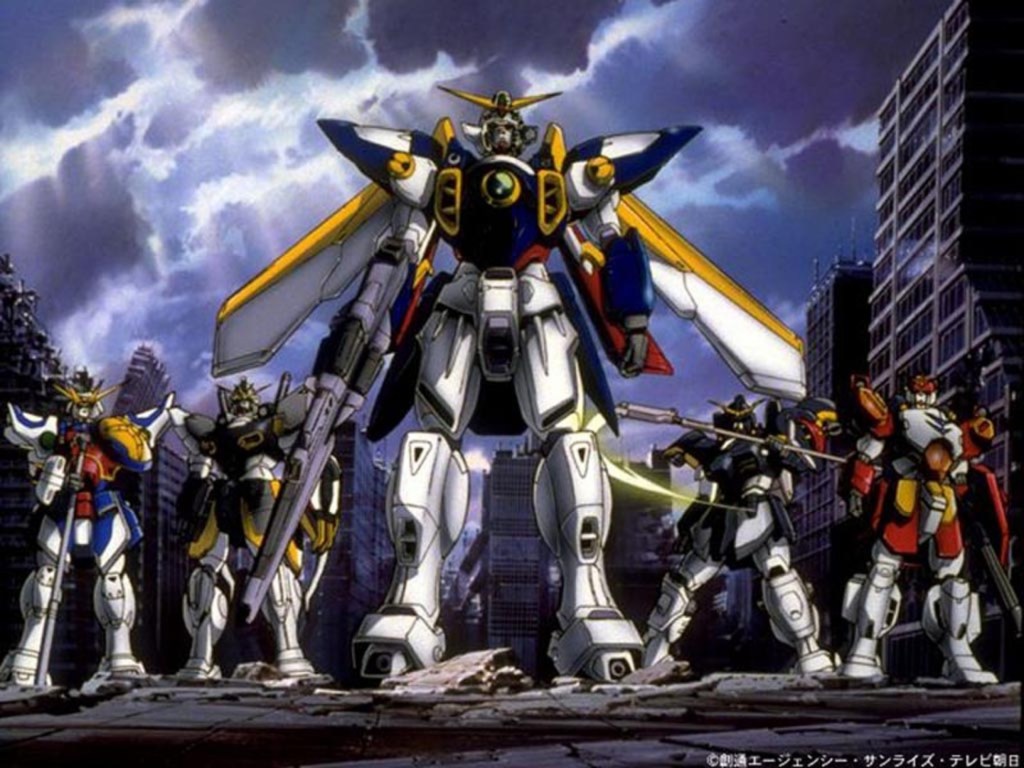
With MechaStellar VER11 releasing late in August, we have a small but powerful update for September a Gundam Wing Update. In addition to updating all the VER10 profiles to VER11 we’ve also added in the Tallgeese III, as well as options to add the Glory of the Losers equipment for the Gundams such as Sandrock’s Armadillo unit, HeavyArms Igel unit, or Shenlong’s Liaoya sword.
As we mentioned before, Rules updates are now on a 6 month schedule, that way players can master the game without having to worry up minor rules tweaks each month. That said, please keep giving us feedback so we can add it into the 6 month update. Here’s the VER11 After Action feedback form: https://forms.gle/aszwjLG1S2fs1wSQA
For this month’s update we have a few format tweaks, weapon balance updates, as well as an expanded pilot upgrade system. See below for a summary of updates.
UPDATE SUMMARY
Formatting
For Elite Pilot swaps, used the last column to show how many bonus points a pilot costs.
Fixed an embarrassing typo in the upgrade rules, Ace Pilots get 6pts for upgrades not 8
Various typo and formatting fixes
Weapons & Mech Profiles
Update large beam cannon and mega beam cannon affects GP03, GP00, FA7th, HFA 7th, Virgo
Updated Heavy Beam cannon affects Neue Ziel, Guncannon II, Virgo
Updated Heavy Gatling affects Heavy Gundam, Heavyarms
Updated Fire SPT Missiles to be Opener Trigger.
Updated grenades to be AOE
Added Guntank II
Updated GM Spartan to Performance 2
Rebalanced GP01Fb, GP03, HFA 7th to have Move 8″
Updated some named pilots to use the new upgrade system
Pilot upgrades
Rename overzealous to daring. Renamed Burning Soul to Hot Blooded.
Some traits got more expensive, like Steel Resolve
Added the following traits: Hot Blooded / Burning Soul, Fearsome, Guts, Persevere, Deadeye, Swift Strikes, Tactician
Standardized the pilot point system for pilots with a special trait like Newtype, Daring, Steel Resolve etc.
Better late than never, for the August MechaStellar Monthly Update we are releasing MechaStellar VER11. You can find the update rules and profile sheets on the MechaStellar game downloads page.
It’s been a long road from the VER11 announcement to release. Check out the VER11 Roadmap post for all the design goals that went into VER11.
Overall we want this to be the best Version of MechaStellar that is Fast, Fun, and most of all easier to teach to new players. Switching to a “dice roll only” core mechanic does a lot to accomplish this, and we’ve rebuilt several systems like Pilot Skills, and Elite units to enhance this. We think both VER10 and VER9 players will find a lot to enjoy in VER11.
We also want VER11 to be a more consistent and reliable edition which is why it went through a large amount of playtesting to try and iron out all the fine details. Some feedback from our beer & pretzel style gamers is that constant rules tweaks and balance updates made things hard to follow and easy to forget rules changes. Since MechaStellar started off as a garagehammer game we want to make sure we take care of those players too. Our plan is to only update the core rules every 6 months, rather than trying to patch the game every 4 weeks. (We’re still going to be updating the unit roster each month as normal.) That said, if you find something that’s broken, please let us know so can fix it for the next update.
Unlike VER10 MechaStellar is also launching with the Gundam Build Fighters rules from day 1 which has also been expanded to include simple to follow instructions on swapping out pilots and weapons and a system to design your own custom pilot.
With that said, please enjoy MechaStellar VER11! On the initial release we have Mobile Suit Gundam Universal Century (UC) from 0079-0083. In the upcoming weeks we will be releasing Zeta Gundam, CCA, Super Robots and Warships. In October or November we will release Gundam 00 which will be the perfect accompaniment to the new Trigger Mechanic. Look forward to it!
Please vote in the update poll to let us know which Tier 3 units you would like to see next!
As an aside, as the layout editor I wanted to say thank you all for your patience. We had planned on releasing VER11 in August and the rules team finished before 01 August, but at the end of July I decided to update the format for VER11 and many profiles now use the bottom right quadrant to store the mobile suits weaponry as well an easy reference if you want to swap out pilots. While it took a lot of time to implement (almost 2 months total to update UC Gundam from 0079-0083) I think it was well worth the effort but keeping the profiles cleaner and also minimizing profile bloat.
For example for MechaStellar VER10 final, the UC profile sheets had 86 profiles for Zeon and 69 profiles for the Federation. In VER11 there are 64 profiles for Zeon and 60 profiles for the Federation (including 1 new one). In total a reduction of 31 profiles. With less profiles and more room from a cleaner layout we were also able to increase font size.
Also, due to an unfortunate glitch, all of our images got stretched and de-rez’d so I had to remove all of them and manually insert and resize all of them which unfortunately takes a lot of time. On the plus side, it gave me a chance to adjust the file size for all the images, so the Mech profiles have gone from 32mbs down to 16mb in file size.
While the end product may not seem that different from VER10, altogether it took about 6 hours a week for 8 weeks to make this all functional. I’ve learned a lot since then, and implemented a few tricks that will make updating Zeta, CCA and Super Robots much faster, so please look forward to that and thank you for listening to my layout editing gripes.
In the last few weeks while waiting for layout editing to finish, the rules team had a chance to tweak various rules and also update Victory points based on feedback from our all-star 40k players. The Dev team also did some experiments regarding break saves, to resolve a problem with shields at a low power levels (One Year War) and while it developed a novel concept, ultimately we went with the simple solution that Siege weapons now also reduce Shield level by 1. Thank you to all the playtesters who provided feedback on that.
Weapons were also tweaked to try and better align the expected damage for various weapon type, some of the siege weapons in particular were falling behind the crit weapons so various weapons were rebalanced, which is why some of the preview sheets (created 2 weeks ago) may not match the final product. Thank you for understanding!
Thank you so much to everyone who volunteered to playtest. And a big thank you to the Dev team, especially those who came out of retirement just for this update. Thank you to Red, Yuria, Kyle, Tyler, Mike, Dominique, Charles, Rob, Yoshiaki, Sandeep, Alex, Jorel and Luyi; could not have done it without you.
In making MechaStellar VER11 we had a lot of new and interesting design challenges to improve the game. Our overall goal to take VER10 and make it faster, more fun and easier to teach. Finisher is the 2nd most modified Trigger since we started developing VER11, coming in right after Barrage. Ultimately, Finisher was removed as a Trigger but we thought the development process of ups and downs, repeated dead-ends then eventually repurposing Finisher into an alternate system would be worth the deep dive. So keep reading below.
At the start of VER11 Finisher had the following ability.
Finisher
When target is below 50% HP, each Trigger deals +1 Hit. (Can Stack with Critical)
This is probably the simplest and cleanest version of Finisher we ever had looking back on it. It was also quite potent making it the most commonly used combination trigger, combining with Critical, Bullseye, Siege, etc making every combination deadly.
On the flip side, it was completely inferior to Critical outside of Combination triggers. That meant we were always looking for different ways to implement Finisher. Finisher in VER9 and VER10 went through many different revisions providing several different frameworks, some loved, some hated by players. Finisher in VER11 is major improvement over all previous versions, both from a balancing, thematic, and enjoyment perspective. But before we get to the [Finisher Phase] let’s go through Finisher’s evolution.
With the VER10 Finisher Rules of make X+ Hits to Trigger a Finishing Blow we tried with
Finisher
Each trigger lowers the number of unblocked hits needed for a Finishing Blow.
This was very similar to VER10 but didn’t help our lethality problems, or all the problems we had in VER10 so it was scrapped. It also had a number of sequencing problems when it came to attack and defense, when a targets shield could be used, and whether it would be broken (by the finisher). Here’s a DEV chat on the topic.
How about a system where Finisher trigger immediately activates Finisher phase?
Only way this works is to make defender roll first, then attacker, then finisher phase.
Yeah, but sequencing gets clearer for Shields / Siege
Ok, but it gets ugly because now you have to commit to Flash / Iron Wall before knowing the attack. I mean yeah, it might have that Gundam EX Vs feel, but has big potential for feels bad moments; and heavily lets the attacker probe defenses without burning momentum. Again not a bad thing but probably not a good sequence, even if it gave us fun nostalgia for VER 4-9 with defender rolling vs attack.
At the start of VER11, the number of Saves you rolled was still equal to the number of unblocked hits (capped at 5). Same as VER10. We were looking at ways to modify this and make the game less lethal, since high attack beam weapons were still extremely lethal. One option was Finisher.
Finisher
Each Trigger generates an unblockable Hit.
This way a Finisher weapon was creating Saving Throws regardless of the opponents defense roll. A novel concept, but ended up being a mess for mental math later. Around this time we were also developing the saving throw system in parallel which we’ll cover in the next post. At the start there were only Armor Saves (just like VER10) with some unique ones like Stun versions or Push / Pull versions. We then added in a “Finisher Save”. Here’s some DEV notes during this time period
Next version– Finisher triggers generate Finisher saves if there are any unblocked hits. But that gets weird with armor saves and finisher saves having different generation mechanics, Armor Saves is one per hit, Finisher Saves is per trigger , probably confusing for new players.
Next version– Finishers are just Crit weapons, but a passive bonus in the Finisher phase, they cost more than Crit weapons (maybe too strong and doesn’t help me blow up shields, without going to finisher phase)
Next version– Finisher weapons all have Siege (thus every roster can deal with shields now) and also a bonus during Finisher phase, which is Crit on trigger, they cost more than regular siege weapons
Next version– Finisher does generate finisher saves. Turn ARM PEN weapons into PEN 8+, now all saves depend on triggers {{this is when we prototyped what became the final Saving Throw system}}. Save = Triggers lowers lethality on beams, if we kept it as unblocked hits = saves then finisher saves would be super overkill.
However, it can get kind of weird if you have more saves than hits, do you still cap saves with hits? What happens if you get 5 Triggers and thus 5 Saves but there only 2 unblocked hits; okay well I guess 2 Hits and 5 Saves. Alright, but what about squads? How do I split up 2 hits and 5 saves across 3 units??? {{We eventually solved the Squad issue}}
Next version– Unified trigger and save mechanic. [E]nergy weapons and Finisher weapons cause armor saves and finisher saves respectively, where # of Saves = # of Unblocked Hits (Max 3). The trigger for these weapons raises the save cap by 1. For example, Finisher 8+, roll 2 8s, the cap is now 5, better get 5 unblocked hits through to maximize that
Next version– Finisher = Crit if target HP<50%, or Tac Adv (Blindside, high ground etc.). Maybe anti grunt if we do Frame 1-2. Conditional = Bonus in Valor phase.
Next version– That was way too complicated, let’s revert back. 1 Trigger = 1 Save. If there are 0 unblocked Hits then there are 0 Saves. Otherwise, Hits and Saves are not dependent on each other. How about we just get rid of Finisher Saves for now, and Finisher = Each Trigger is DMG+100.
This became our go to Finisher for the longest time.
Finisher
Each Trigger gives DMG+100 to each unblocked Hit
That said, as hinted in some of the DEV Notes earlier, we had also been developing a [Finisher Phase] system simultaneously. Eventually, we combined that concept with the Valor skill such that using Valor meant entering the [Finisher Phase] on your attack. Valor was extremely well loved by playtesters. But more on its development later.
As we developed the Finisher Phase we also realized that we no longer needed to have separate Finisher weapons. You didn’t need to have “Drill Attack” and “Giga Drill Breaker” as separate weapons, each costing separate points (and often a lot of points). Instead you could “Drill Attack” who’s special ability was “[Finisher Phase] Role change to Breaker”. Thus your regular weapon with Pierce as its Trigger switches to a combination trigger like Breaker (Pierce + Crit) during the Finisher Phase.
We could then apply this to various fighters, GaoGaiGar’s Heaven and Hell going to [Finisher Phase] Role Change Overkill, Wing Zero’s Twin Buster Rifle max output would [Finisher Phase] Role Change to Dominate, Sky Gridman having a laser circus would [Finisher Phase] Role Change to Swarm. It created a lot of distinct possibilities with minimal mechanics needed, instead reusing what was existing.
Your super robot could attack normally and when you wanted to fully commit to the attack and use Valor, suddenly you cut loose, do the impossible and make a massive powerful attack. It meant we no longer had to make Finishing moves dependent on Momentum (now Morale Points), or Power, or single use, etc. It was just dependent on you using the Valor skill. Everything was finally coming together.
Now that the [Finisher Phase] system (and the 1 Trigger = 1 Save System) was completed we realized it was time to say goodbye to Finisher as a Trigger. It was a fun way to start of VER11’s development, but now it’s true power was codified in a distinct game mechanic, satisfying one of our design goals to leverage existing systems rather than create new mechanics. In this case, leveraging the valor skill (which itself went through a dozen iterations) and weapon abilities to build out the finisher phase creating dramatic and anime accurate moments on the tabletop.
In making VER11 we had a lot of new and interesting design challenges to improve the game. Our overall goal to take VER10 and make it faster, more fun and easier to teach. Weapon Triggers definitely fulfill the more fun part and so far its been fun to teach new playtesters that “yes you can blow up cover with your first attack then fire on the exposed target with your next attack”. Bombard and Siege went through a lot of revisions, one eventually being removed while the other was heavily modified until it reached it’s final form which we’ll discuss in this post.
At the start of VER11 development Bombard and Siege had the following abilities:
Bombard
If the target has no Cover, each Trigger is a Critical Hit.
Bombard was priced cheaper than Crit, a CRIT 9+ weapon is the equivalent of a Bombard 8+ weapon.
Typically used on Cannon types and some missiles
Siege
Each Trigger rolled blows up 1 level of Cover, i.e. reducing Level 3 to Level 2 Cover or Level 1 to Level 0.
If you attack Cover directly the weapon trigger becomes Siege, if it was already siege, improve your Trigger TN by 2, i.e. Siege 9+ to 7+
Typically given to Bazookas, some missiles and some melee weapons
We went through several variations of each trait, trying to preserve the combined arms combination where Siege weapons benefit bombard weapons. Siege was a tricky beast, we were experimenting with Siege also destroying or weakening Shields / Armor as well as Cover. Triggers could blow up Cover, or lower a targets shield or armor level by 1. Whether it was permanent or temporary was still up in there. Here’s one DEV conversation
I think I figured out how to fix sequencing on Siege
and make the rules text shorter
so each Siege trigger lowers Cover or Shield bonus by 1. Cover is permanently lowered, Shield is for the rest of the round (synergy by activating bazooka unit first). The iron wall skill reactivates the shield bonus
To permanently break shields, we’ll have to rely on Finisher weapons
so finisher needs to be common either on common weapons like a beam saber
or maybe on everyone’s generic close combat [cc] attack
At the time of this discussion, Finisher weapons were updated to cause a “Battle Damage” save which could blow up a shield first and foremost, and if target had no shield then it might cause system shock like severe damage to a (weapon), leg (propulsion) or head (main camera). This eventually morphed into “Break Saves [BR6+]” and “System Shock” Saves which we’ll discuss later. Likewise, we’ll talk about the Finisher Trigger in the next post.
While we made headway with the shield breaking philosophy moving into Break Saves, Siege continued to be a difficult Trigger to work with, if we wanted to have Siege affect a targets Shields, Armor, or Defense in addition to blowing up cover. Sequencing in particular for the attack action (dice rolls -> triggers -> skills -> bonuses like Cover and Shields -> Defender skills) and Siege was quite messy since the Trigger would occur before the Defender could use Skills, so having a Skill that would prevent your shield from blowing up got messy in the sequencing.
So Amuro would use either Flash or Iron Wall depending on who he’s fighting, so we could have Flash or Iron Wall skills prevent your Shield from being reduced or broken
Yeah, but right now defender doesn’t choose skills until after attacker has resolved attack and triggers which means Siege triggers can reduce the Shield to 0 before the defender even chooses skills
right..well, we could have the skill restore the shield bonus, like if you used Iron Wall this turn, restore your Shield bonus
it feels like we’re just making this more complicated than it needs to be
Likewise, we run into problems if we give Siege a passive bonus like +1d10 ATK if target has no shield. Does that activate if the target started with a shield, but then your triggers blow up the shield, at that points do you add the extra die. All that spawned this DEV conversation.
I don’t like Siege being deadspace if target has no shield or cover
Run through several ideas, best thematic one is that Siege provides system shock saves (Battle Damage) if target has no shield or cover bonus.
However, for sequencing the cleanest way to do this is to make sure this trigger only happens if you start the attack and target has no Cover / Shield bonus. Basically attack 1 needs to annihilate that shield bonus, while attack 2 can cause battle damage.
Our VER11 Design Goal was to make things fast and fun without being overly complicated. Obviously these weren’t working so we tried a few more ideas. We also briefly considered Siege Triggers creating a “DEF penalty” like so
If target has Level 0 Cover each additional Trigger is -1 DEF bonus on this ATK only
DEF Bonus includes Shields / Barriers / Armor etc and is Min. +0 DEF.
i.e. Level 3 Cover, 5 Triggers, Level 0 Cover and target has DEF-2 (Min 0)
Problem of course being, -DEF is the same as +HIT, so it’s mathematically about the same as CRIT but with a limit that DEF can’t go below 0. This idea went belly up as well.
We considered Siege Trigger = +100 DMG if target has no shield bonus. But that stepped on the toes of Finisher, and also became a self-feeding ability since Siege also weakened shields. Not to mention the sequencing issues of does this apply during an attack when the shield is destroyed or not?
Eventually we moved on to just allow for Siege and Bombard weapons to have deadspace, times when the triggers won’t happen, but give them an always on passive instead. And so we got:
Bombard (Passive): If target has a Shield gain +1d10 attack
Siege (Passive): If target has no Shield gain +1d10 attack
Shields were much cheaper at this point of development, because Break Saves could wipe them out. And so we added these passives that way if your opponent had an all shield army, you were incentivized to bring Bombard weapons. This was okay for a bit but felt kind of gamey. While we were going through another pass on the rules to trim things that felt excessive, complicated or redundant, we eventually we got rid of Bombard, since Bullseye was taking over the no-cover Trait.
So then what do we do with Siege?
Siege was a fan favorite ability, and we held onto this Trigger until the final week. It was so popular that we even included a gameplay example in the core rules to reenact a favorite tactic of Justice Gundam which was to throw it’s beam boomerang and try to destroy a piece of cover. If they lucked out on the die roll and sliced through that building, they then used its cannons against the exposed target (Bombard weapons gave a Crit vs targets without Cover). The player who discovered that combo still thinks they are a genius =)
That said, Siege did eventually change. Not because of that combo, no in fact we loved it and everyone loved the “Trigger = Blow up that many levels of Cover”. The problem became that, if there was no Cover then Siege did nothing. And late in development 50% of Combo triggers were Siege + another ability. So having 1/2 of your combo trigger be useless if the target had no cover felt rather underwhelming.
One of the goals of the recent combat redesign has been making every weapon trigger feel both intuitive and exciting.
Siege triggers destroyed Cover was awesome! It produced some spectacular moments where a lucky roll could flatten an entire defensive position, but it also had a few downsides:
The trigger was only useful when Cover was present.
Occasionally you would roll 0 Triggers and not interact with Cover at all.
Siege didn’t combine well with other trigger abilities.
It limited the design space for Super Robot finisher weapons.
The new direction is to separate the battlefield role from the trigger effect.
Siege Passive
Reduce the target’s Cover Level by 1.
Instead of hoping to roll enough triggers to demolish terrain, Siege weapons now always accomplish their primary purpose—they weaken enemy fortifications. This makes Siege more reliable while reducing swingy outcomes where one lucky attack completely erased multiple terrain features. With Cover removal moved to a passive ability, Siege triggers are free to become something universally useful. The current direction is:
Trigger
Generate +1 additional Save.
This creates a clear distinction between the defensive-breaking roles.
Critical = More Hits
Pierce = Harder Saves
Siege = More Saves
Rather than punching through armor like Pierce, Siege represents overwhelming structural damage—more systems failing, more secondary explosions, and more catastrophic impacts.
This also opens the door to much more interesting combination triggers. Previously, many Super Robot finisher attacks defaulted to Breaker, because it was the only melee combination that consistently felt rewarding. With Siege becoming a universally useful trigger, there is now room for another powerful melee archetype, Overkill.
Breaker
Critical + Pierce
Each Trigger becomes:
+1 Hit
+1 Save TN
This represents concentrated penetration—drills, lances and radiation attacks designed to punch through or lethally bypass heavy armor.
Overkill
Critical + Siege
Each Trigger becomes:
+1 Hit
+1 Save
Rather than piercing, these attacks simply overwhelm the target through sheer destructive force.
This is a much better thematic fit for weapons such as giant hammers, rocket punches, pile bunkers, and other crushing finishers.
In making MechaStellar VER11 we had a lot of new and interesting design challenges to improve the game. Our overall goal to take VER10 and make it faster, more fun and easier to teach. Weapon Triggers definitely fulfill the more fun part and so far its been fun to teach new playtesters that “yes you do get to roll another bucket of dice” and see their smiles in response. Since Barrage was the genesis of weapon triggers, and also the one that experienced the most changes we wanted to write about it first.
For Reference here’s how the Barrage discussion started
Enfilading fire = We could make Barrage an anti-squad weapon. But then it would only be useful against squads and not useful every game.
Sustained fire option = We could have barrage convert failed failed hits into hits, low power, not too exciting, and doesn’t keep parity with other weapons
Triple Crit option = Maybe Barrage triggers could be worth 3 Hits instead of Crit which is 2 Hits. Fun and definitely a hail of gunfire.
Dakkadakka option = threshold hits generate extra dice. Very fun, but we now we have an issue of weird mental math with dice overflow. Like start adding dice to your pool, but then if it goes over 10d10 then it’s extra hits. It’s not too strong but it’s not smooth at all.
SuperDakka option = What about an option where you reroll the trigger dice. And keep reroll trigger dice until you stop rolling triggers? This was max. fun, but then one playtester demonstrated how annoying it can be when you “pick up, and drop a die” and magically it keeps landing on the same number.
Indeed, even Buzzsaws will have the Barrage trait
From there we settled on the following:
Barrage 8+
Every 8+ is an exploding hit, after counting Hits & Triggers. Reroll all your Trigger dice for bonus Hits. This reroll is considered a separate roll and does not count against the 10d10 dice cap.
Now we had to sanity check this in a couple games to see how powerful this is compared to Crit weapons. As mentioned in a previous post, we decided against all weapons have CRIT on 10s and instead CRIT would only be for certain Triggers like CRIT or BULLSEYE.
So rolling a 10 on Barrage was just a regular hit (that you got to roll again). Barrage has been the most fun ability, but statistically it’s slightly weaker overall than Crit, but it does have a higher chance of getting at least 1+ (albeit lower DMG) hits through.
The DEV Discussion looked like this:
We need to explain how to pick up dice in quick dice section. First remove the 1s and 2s. Then pick up all hits that are not threshold, i.e. Barrage 8+, pick up 3-7 as hits, and count your hits. Then pick up the threshold and count (don’t forget crits) and reroll them, then final count.
Actually maybe we should remove crits.
Definitely remove crits
Okay so if Focus moves back to +1 Hit and Hit on a 3+, then we need to make barrrage always hit on a 3+ otherwise we have a massive sequencing pitfall where players might scoop dice before focusing then forget how many 3+ they had.
At the time we were developing Barrage, some of the pilot skills were getting Overhauled. Focus would no longer be the “Hit on 3+” skill because now elite pilots were already hitting on 4+ or 3+. Later, one of the in development pilot skills would let you hit on a 2+. With all that in mind, we realized we would have sequencing issues with barrage.
If you wait for the reroll to declare skills, do you then have to go back in time and count those dice with the better Hit Target Number? What if you declare it before the reroll, but then it didn’t matter because all your reroll dice were Hits anyways.
From that discussion we decided that:
Barrage (Passive): This weapon always hits on a 3+.
[Anti Squad] Elite Pilots get +1 Hit per Model, Ace Pilots also get +2 Hits per model in enemy unit.
Eventually, the “Anti-squad” effect got moved into an upgrade ability.
We were also considering a combined arms ability where Barrage causes a Suppression effect if the target is <50% HP they must make a Morale Save or lose a Move Action. This would combo with Bullseye which Crits against crippled targets that have only one move action. Ultimately, this train of thought let to “Mobility Saves [MB6+]” which we’ll discuss in the Saving Throw post.
Since Trigger and Skills were in parallel development paths, we had to keep updating Barrage as well. When the “Hit on a 2+ Skill” went through testing, Barrage instead turned into
Barrage (Passive): The Hit on a 2+ Skill is [M-0] for Barrage weapons, however, you may not use the Zeal skill.
Eventually that skill was removed entirely (who knows, it may reappear one day), so Barrage just reverted back to
Every 8+ is an exploding hit, after counting Hits & Triggers. Reroll all your Trigger dice for bonus Hits. This reroll is considered a separate roll and does not count against the 10d10 dice cap.
But it did end here….
But it doesn’t end there. In the last week of VER11 development we came to a breakthrough. The other Triggers had hit roughly even parity, but Barrage still lagged a bit behind, a fun trigger but mathematically slightly weaker than all the others. While we were doing the very last round of testing, one DEV asked:
Is there any reason why we only reroll the triggers? What if we rerolled all Hits instead?
The reasoning was that we didn’t allow for rerolls to spawn Triggers. The reason was, back then, before we developed the Save system, we didn’t want any more triggers or saving throws because that could cause an insane tidal wave of damage. If they reroll all those dice, players might mistakenly assume they could hit and trigger again.
However, since the Save system also finished its parallel developed, the number of saves was drastically reduced per attack action, and Barrage weapons all had 1/2 DMG saves we realized there was no longer a reason to prevent additional Triggers or Saves. And we so we come to final barrage.
Barrage
After counting up Hits & Triggers, remove all Misses then reroll the remaining dice one additional time adding any new Hits or Triggers to the original total.
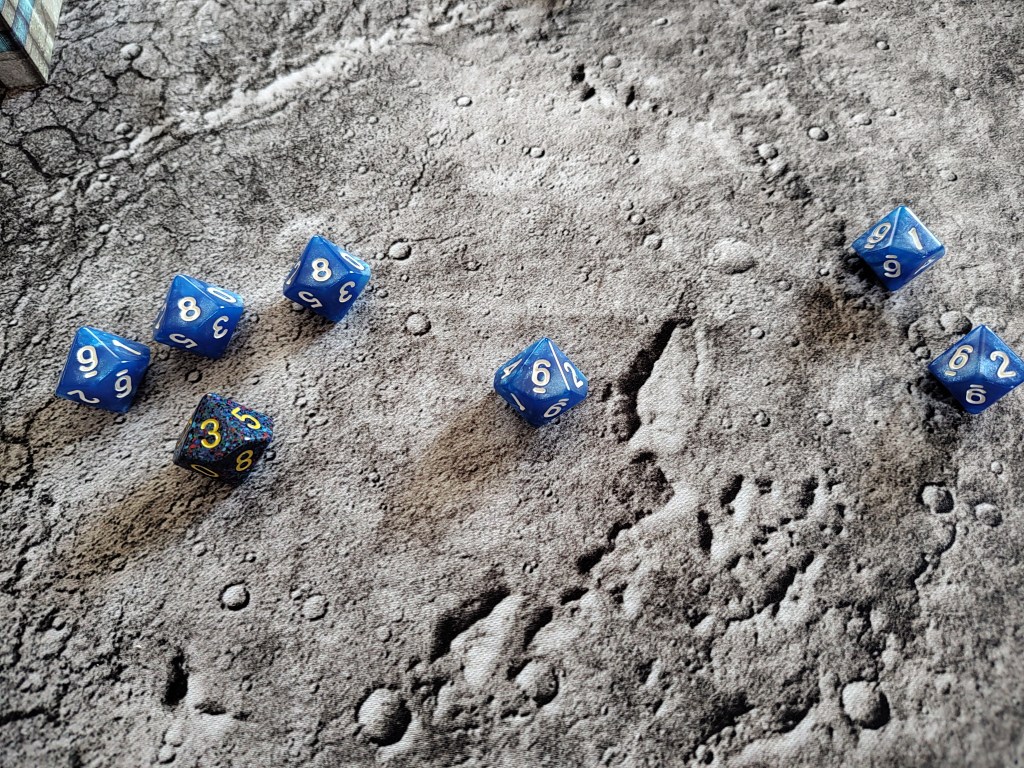
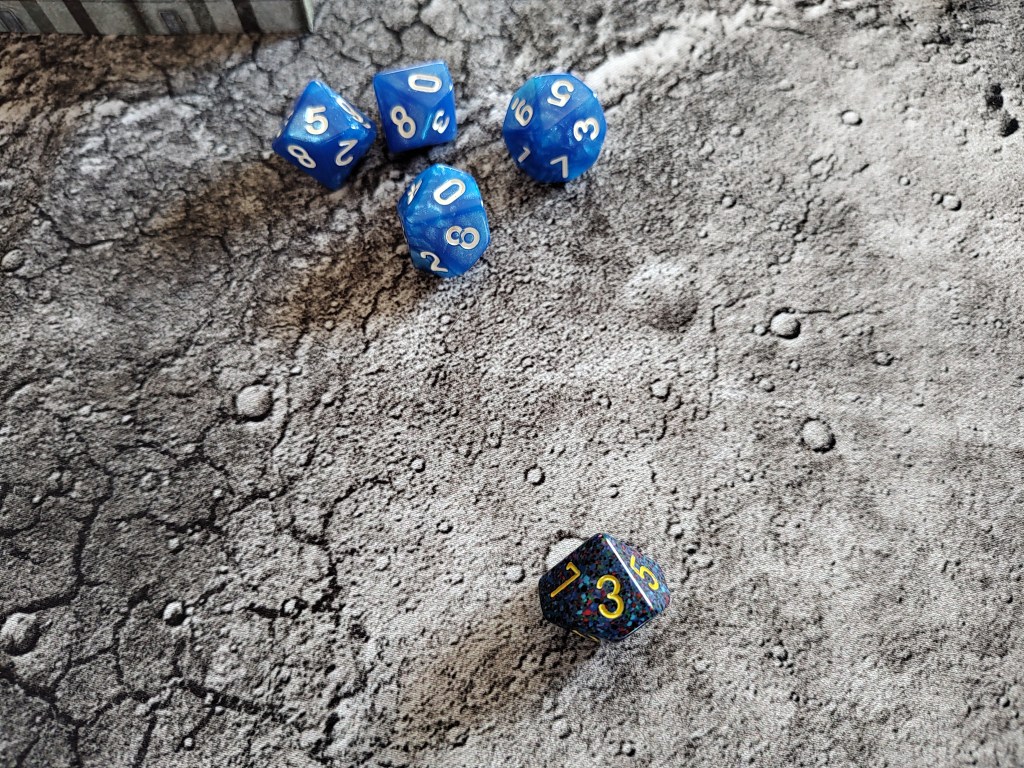
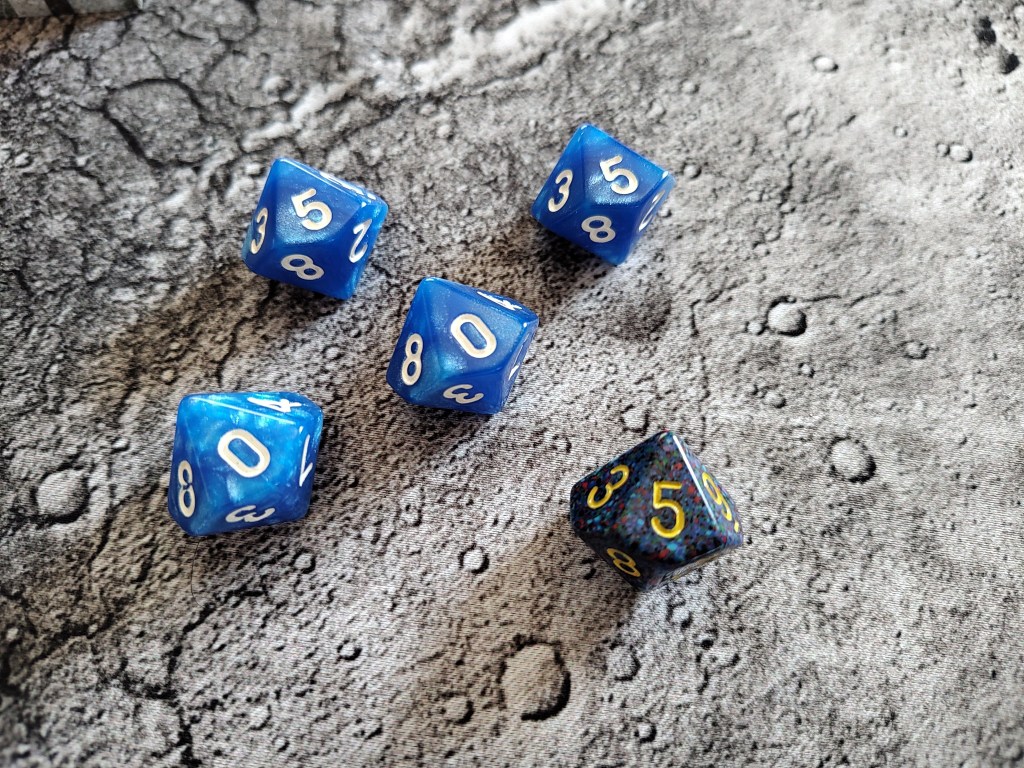
First Count your Triggers (especially for Barrage) – Place a different color die showing the number of Triggers. This marker reminds you how many saves it will cause later. Pictured above the unit hits on a 5+ and will Barrage on 8+. They placed a different color d10 showing the number of triggers [3]. The player then removes any misses like the [1&2] then sifts through the Hits [6] and Triggers [8,8,9].
Barrage – At this point the player says to their opponent “OK, 4 Hits and 3 Triggers”. Then the attacker picks up successful (TN 5+) dice [6,8,8,8] and rerolls them into [5,5,10,10] = +4 Hits and +2 Triggers. “Ok, 8 Hits and 5 Triggers, your turn for Defense”.
Next post we’ll talk about the evolution of Siege & Bombard.
In making MechaStellar VER11 one of our design goals was to repurpose existing stats to accomplish some heavy lifting on core mechanics instead of having to rely on specific traits or abilities. Like the Morale stat before it, Sensors became part of this paradigm shift, becoming an invaluable stat to boost your weapon Triggers.
In VER10 we debuted Dual Sensors profiles for Snipers and Firepower types, to represent how they had advanced sensors for long range combat whether it be sniping or long range bombardment / indirect fire, while the second value referred to their regular Sensor value. We also upgraded sensors to let it be both offensive and defensive, giving you a bonus d10 to ATK or DEF if the target was in your sensors range. It was a good idea on paper, but was often forgotten until later leading to many times where an attack was finished and one player went “WAIT, I forgot I got +1d10 to DEF because you’re in my Sensors range”. We wanted to avoid that situation in the future.
Still, we had to come up with an idea that would make Sensors valuable, not just for shooting characters. Something that would benefit melee centric characters. We experimented with a few mechanical ideas, but actually one of the Dev’s had a great idea about Sensors as a utility instead of a combat stat. And so we have the “Sensors Sweep” action.
Sensors Sweep
Designer’s Note: This is a mission-oriented action to earn VP. Create a narrative or use one of these examples: “Locate a missing scientist”, “map the battlefield”, “find the asteroid demolition charges”, “New Mech telemetry”, or “Analyzing Reactor Signatures”.
VER11 Scan a Control Point (CP) or enemy unit within Close Range Sensors, neither of which have been scanned before. Gain VP = 10x [Your Frame + Performance Level].
If you are able to capture that CP, do so immediately.
The idea for this action was pulled from the VER10 Wargame rules for “Actions on Objective” which said:
It can represent searching for a missing pilot / scientist, secret cache of equipment, or top–secret design information. It can also represent performing necessary actions to complete the mission like setting demolition charges to break apart an asteroid or destroying the power conduits in a colony laser.
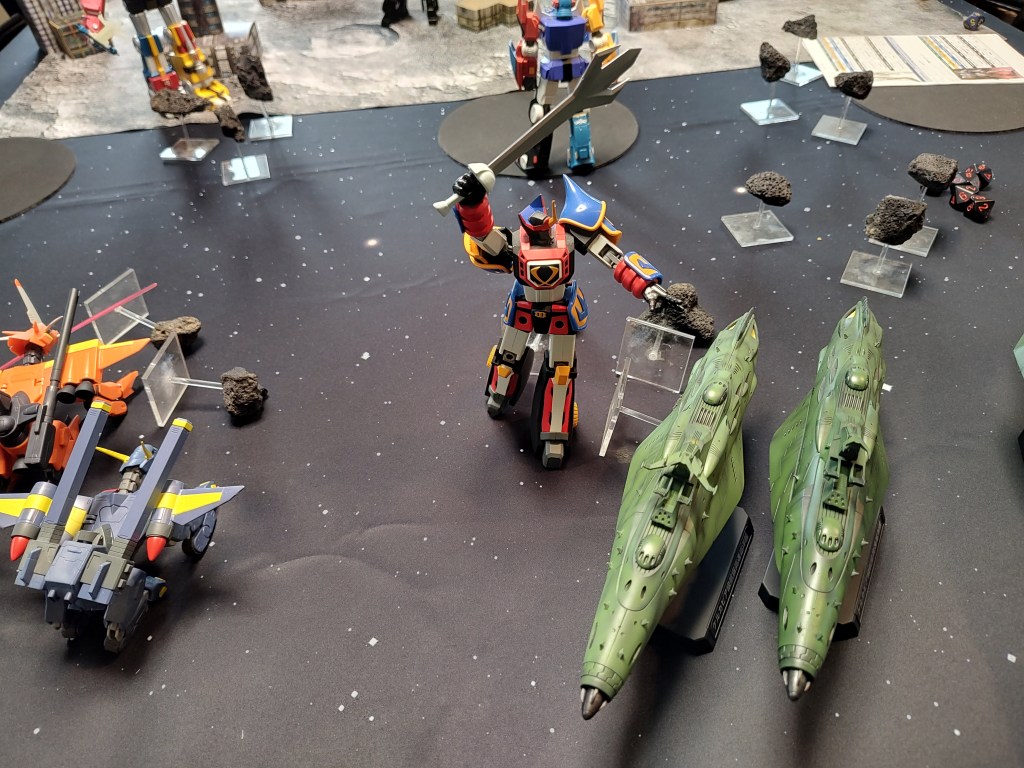
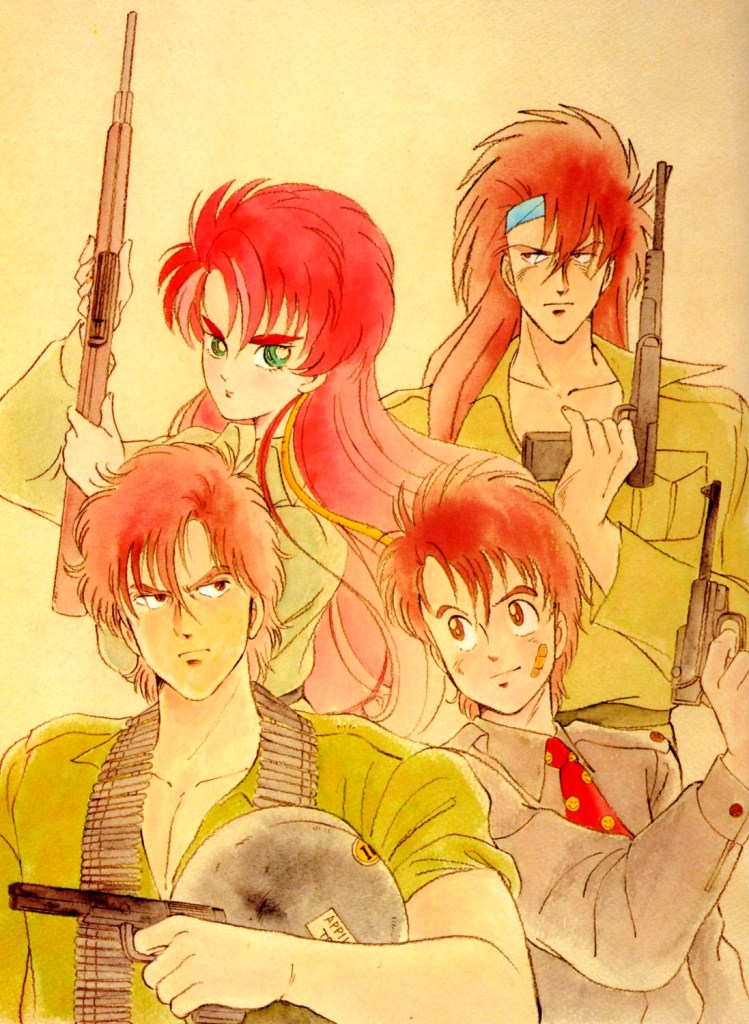
Now it’s integrated into the MechaStellar base game as a fun and useful utility to earn VP while playing the game. It’s a great way to simulate the various mecha shows, both real robots and super robots like Dancouga pictured above where each mission (or episode) isn’t centered around fighting but instead a very specific plotline like locating a missing person, making contact with rebel forces, finding the enemy mind control machine etc.
We briefly considered letting it generate Morale Points (Momentum) but decided against it. However, it has become an extremely useful ability to capture a CP without having to end your turn on top of the CP. Giving players one more action to use instead of burning 100% of your actions attacking the enemy. Also very valuable for our strategists with a cheap low performance rear echelon unit.
Long Range and Close Range Sensors
That said we still wanted that second sensors value to have more meaning, and we knew that Sensors = Defense bonus would not be returning. So we took some inspiration from Armored Core and now we have a Long Range Fire Control System (FCS) and Close Range FCS. So a Sniper might be Long Range Sensors 24″ and Close Range Sensors 0″, meanwhile a Battler is 0″/8″ and a Versatile unit is 8″/8″ which gave a really strong unit combat role identity.
The Long Range sensors would improve shooting attack while close range sensors would improve melee attack. Initially we were hesitant to give melee a boost, since in VER10 every unit had a “Close range stat” of 8″, but then we decided to make that melee or versatile types only, so now those units would get a bonus with beam sabers while snipers and firepower types would not. Likewise, your melee monster isn’t getting a shooting bonus.
From there we also adjusted which weapons would count as melee, making the cutoff roughly 20″+ = Shooting and <20″ = Melee, so Vulcans moved into the melee category, and considering how many melee monstrosities rely on vulcans it actually worked out pretty well. But unfortunately, added about 6 hours of work for our layout editor. Sorry….
Last but not least, we are bringing back “Sensors = Starting Deployment range” from previous editions, but this time only for Close Range sensors. This way you’re melee and front line versatile units can start further away from the table edge, and also allowed us to drastically simplify deployment rules.
As for bonuses, as we mentioned in the Elite unit post, we were trying to eliminate bonus dice abilities to give us more range to work with when developing weapon dice and combat roles, so Target Lock instead provides an extremely powerful “Improve Trigger Target Number by 1”. So if you normally Crit on a 9+, if you get within sensors range you can now Crit on an 8+.
Very powerful and very worthwhile, so for those of you worried about Rapid Fire being removed meant we would go back to castling, there is still a very powerful incentive for getting closer or for upgrading your Sensors with the Unit Upgrade rules. We’re also experimenting with making sensors boost a freebie for advanced grunts to make grunt units cheaper across the board. We’ll see how that works out!
In the next post we’ll start the deep dive on weapon triggers.
While making MechaStellar VER11 we had to fix some core balance problems that arose at the end of VER10, in doing so we’ve created an entirely new weapon system called “Triggers” that we’re really proud of, and we’re sure you will enjoy on the tabletop. Read on for a discussion on how we got here and the genesis of “Weapon Triggers”.
At the end of VER10 we were doing some heavy testing on Warships as well as small size units like Aura Battler Dunbine, VOTOMS, and soon to be Code Geass by popular request. At the end of VER10, power creep led to Machine guns having a base 10d10 attack dice, and were capped at DMG 200. So for a small size machine gun you would see on a Knightmare Frame or Armored Trooper, if we lowered DMG to 100 we’d have to raise one of the other stats.
One option was to raise the rapid fire stat, say from +2 Hits in Rapid Fire range to +5 Hits in rapid fire range. Another option was to increase the attack above 10d10, with those dice being auto hits. So a 15d10 machine gun rolled 10d10 with +5 auto-hits. While the damage wasn’t very high by default, it was a bit demoralizing having so many auto-hits coming at you and having no realistic way to completely dodge the attack.
Then once you toss in pilot upgrades, a legendary soldier like Chirico could be pumping out high volumes of hits on attack and counterattack while also racking up Finishing Blows. Finishing Blow proved to be a very troublesome system, that was awesome for super robots but absolutely busted for any machine gun units, especially small units. We’ll deep dive on Finisher in a separate post.
Still you might be asking? “Well if this is a big problem for small size units, why not just get rid of small size units and make them use the same weapons as everybody else?”
And that’s a valid point!
Problem #1 For people who like versimilitude the 2m mech having the same damage profile as the 18m mech doesn’t feel great.
Still it’s an abstraction so we can make do.
But then we also have these two problems.
Problem #2 – Unfortunately problems were popping up on normal sized units too, especially when you add Squads into the mix.
Plus machine guns + rapid fire was either overkill or unsatisfying.
Problem #3 – Rapid Fire heavily encouraged, getting super close, all the time, and sometimes felt like a punishment for rifles and bazookas who were heavily balanced around 1-2 unblocked hits, where rapid fire range feeling like a requirement to attack any evasive units. Something had to change.
For Warships Rapid Fire range was essential to making them functional
So the DEV Team started working on “Barrage” as a trait that machine guns have, that let them feel like machine guns. Barrage was going to be a DakkaDakka type trait where rolling 10s were exploding dice that could be rolled again. This way, the small machine gun could be DMG 100, but have a bigger Barrage trait, i.e. [Barrage 8+]. Then the question came up, well does Barrage and CRIT stack? So 10s are worth double but also explode into more dice? If it’s Barrage 8+ are those also Crits? Generally, the Devs felt it should be Crit and Barrage because it might get complicated.
So the DEV Team asked a simple question. “What if we got rid of rapid fire?”
“What if you got rid of rapid fire? Replace with battlefield roles like Barrage, Bullseye, Counter, Finisher, etc.”
Now that’s a novel idea.
Getting rid of rapid fire meant we no longer had to worry about going over 10d10, we didn’t have to worry about machine guns spiking up to incredible number by virtue of being 12″ closer, we didn’t have to worry about some weapons being ineffective until you get closer forcing you to always move in for our staple weapons of rifles and machine guns, and especially Warship guns. We wouldn’t have to worry about writing rules to benefit or not benefit machine guns, i.e. DMG<300 or ATK>7d10, we could just say “This bonus applies to Barrage weapons”, and it make it way easier to calculate weapon points without half a dozen nested if statements. This would solve a lot of problem we have had over the years.
Suddenly we would open up a whole new design space for each weapon type, giving them all a Battle Field Role, where rolling this number or better would trigger a special effect; thus the name “Weapon Trigger” was born. Here’s a copy paste from the Dev notes doc, that shows our initial brainstormed ideas from that day for triggers and even a few melee weapon ideas.
Weapon Trigger Brainstorming
Crit 10+ = Crit on a 10 like usual
Counter 7+ = Only these weapons can Counter, but during Counterattack they instead hit on a 7+
We can combo this with the Intuition Skill – Gain Counter 9+, if you already had counter then improve the number by +2
To avoid this becoming super long we should not let the attacker get a counterdefense, but you can still use shields, cover, etc. to block.
Barrage 8+ Exploding dice on 8+, each 8 means rolling extra dice. This will be a separate dice pool so we don’t have to worry about the 10d10 cap.
Because there’s a lot of sequencing issues with pilot skills, this weapon should probably Auto Hit on a 3+, Elite units instead gain bonus Hits per model in the squad making it a great anti-squad weapon
Bullseye 8+ These weapons Crit on a 8+ vs a unit on a CP or a unit with <2 Move Actions (crippled).
Can target any unit, elite units gain a +HIT bonus
Can cause System shock saves to cripple legs
Bombard – Crit on Targets without Cover. Trait for cannons, will combo well with Bazookas (Siege)
Siege 10+ Rolling this number blows up one piece of cover.
Define cover by levels like 1-3, which gives +1-3 DEF. Each time a piece of cover is blown up lower the level by 1.
Maybe Siege should also blow up Shields which was really common in 0079
Simplest might be blow up shield instead of weakening, so if it’s a level 2 S2 Shield, then you need 2 triggers to blow it up, 1 trigger doesn’t hurt it, which would ease the bookeeping burden.
Maybe using the Iron wall skill means your shield can no longer be broken that Turn, but then we run into a weird timing issues for the attack action…
Finisher 8+ = 8s are crits when target is below 50% HP
What about Combination Triggers?
AOE = Barrage (Anti Squad) + Siege (Anti Cover)
Breaker = Pierce + Finisher
CIWS = Barrage + Counter
Dominate (Warship) = Bullseye + Finisher?
IDF = Siege + Bombard?
Overkill = Crit + Finisher?
Weapon Type Brainstorming
Drill = Pierce
Scythe = Finisher
Saber = Crit or Counter?
Axe = Crit
Hammer = Siege
[CC] = Bombard or Counter?
A lot has changed since then, some triggers like Barrage have merged, others like AOE and IDF have become separate bonus Traits, but overall many Triggers are still very similar to their original incarnation. Before we start the deep dive on Weapon Triggers for Barrage / Bullseye, Bombard / Siege, and Finisher we’re going to take a small detour for Sensors and Target Lock which instead of bonus attack dice will instead modify a units Trigger value.
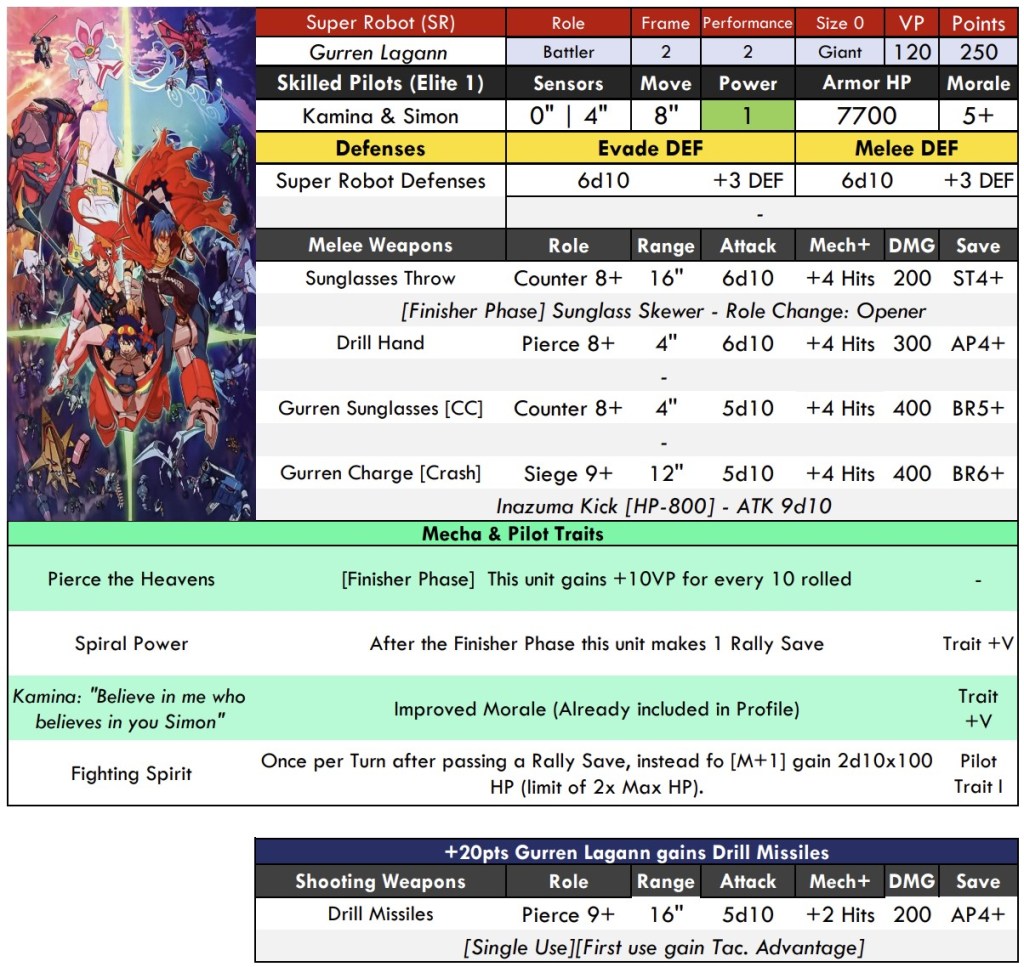
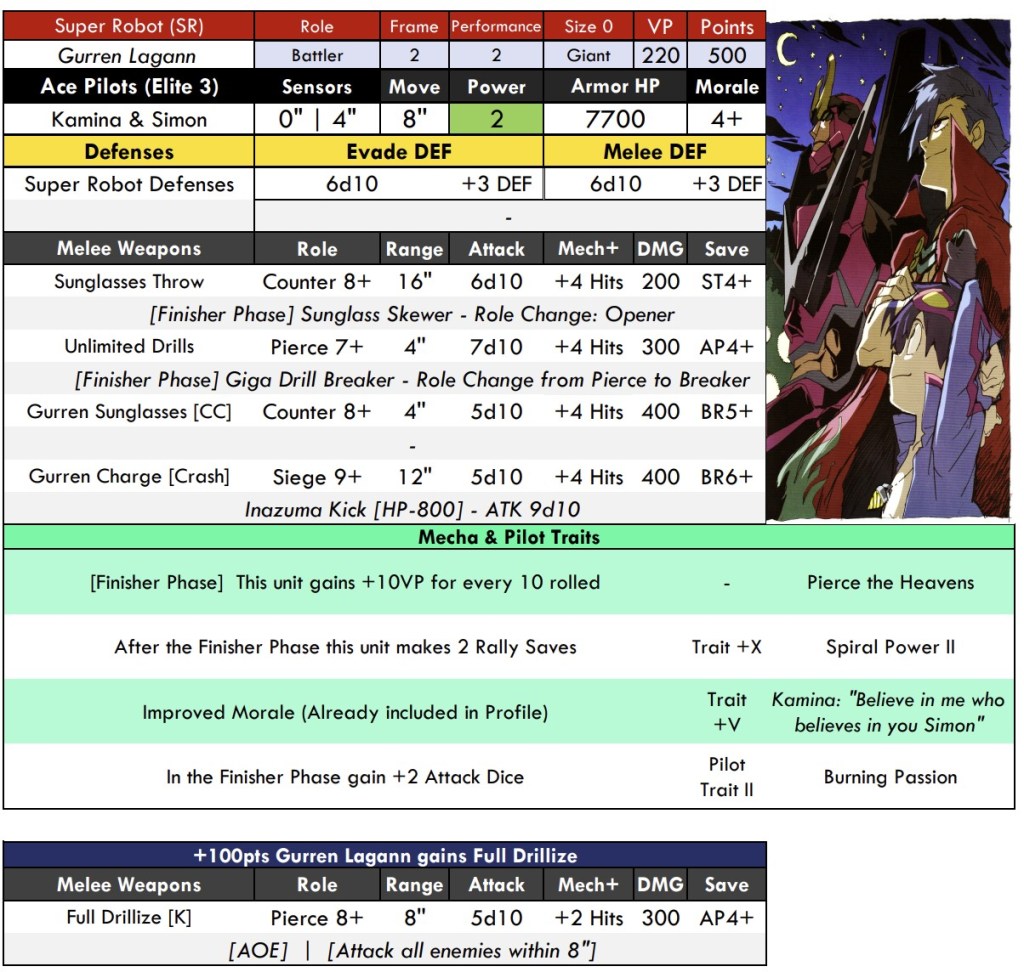
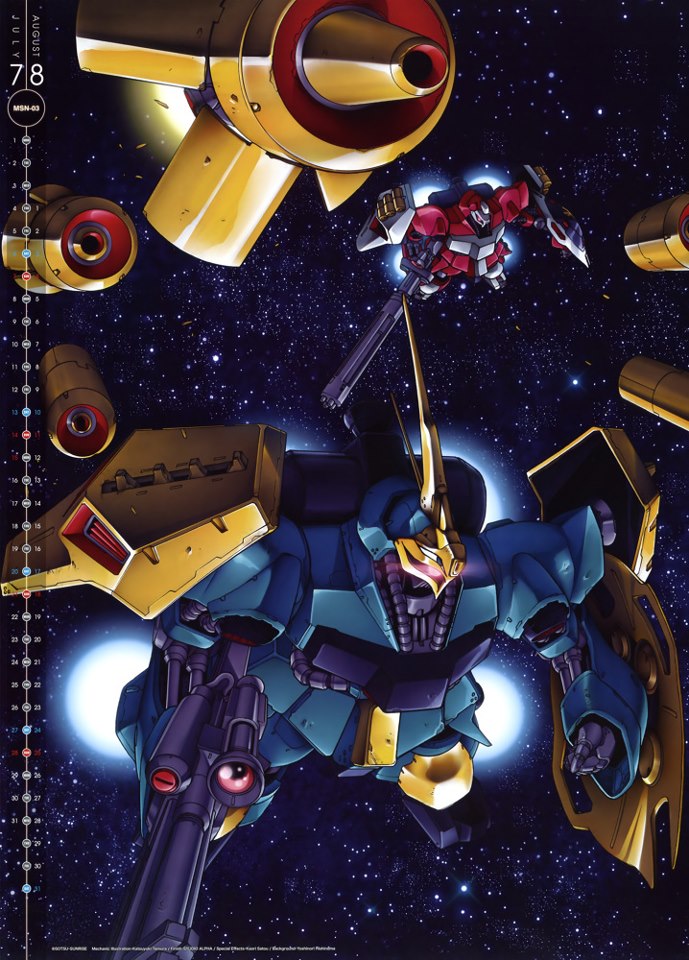
Here’s the profile previews for Gurren Lagann! Feel free to share your insights and questions in the comments section below. Even “hey you made a typo” helps the layout editor a lot! Thank you!!
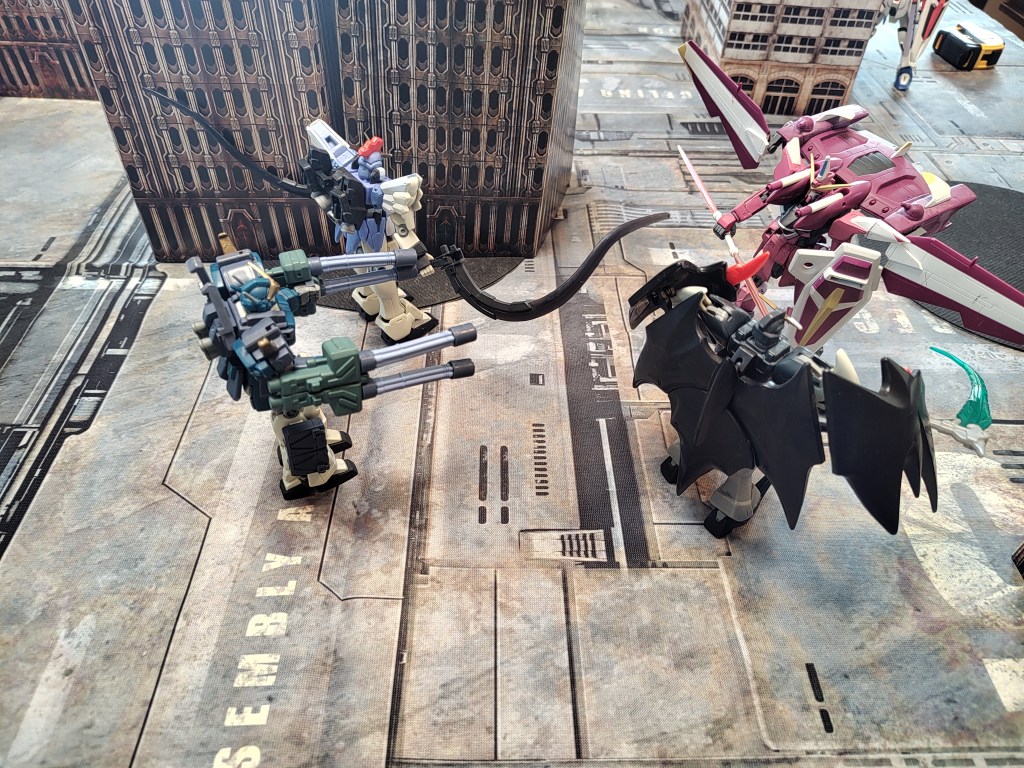
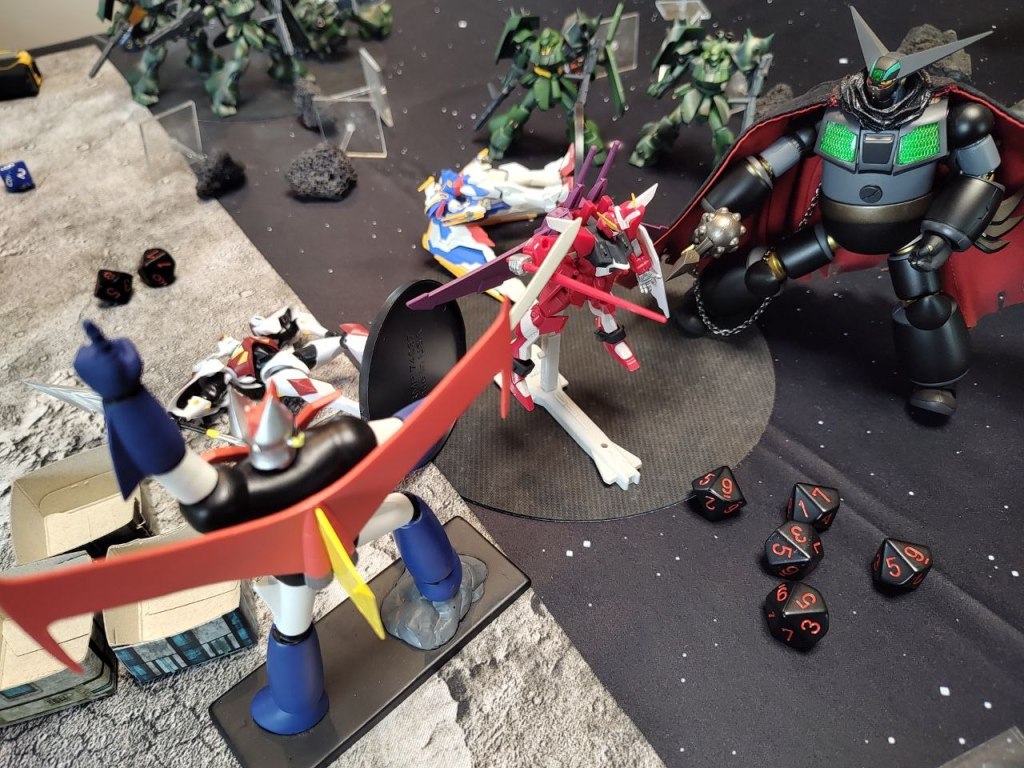
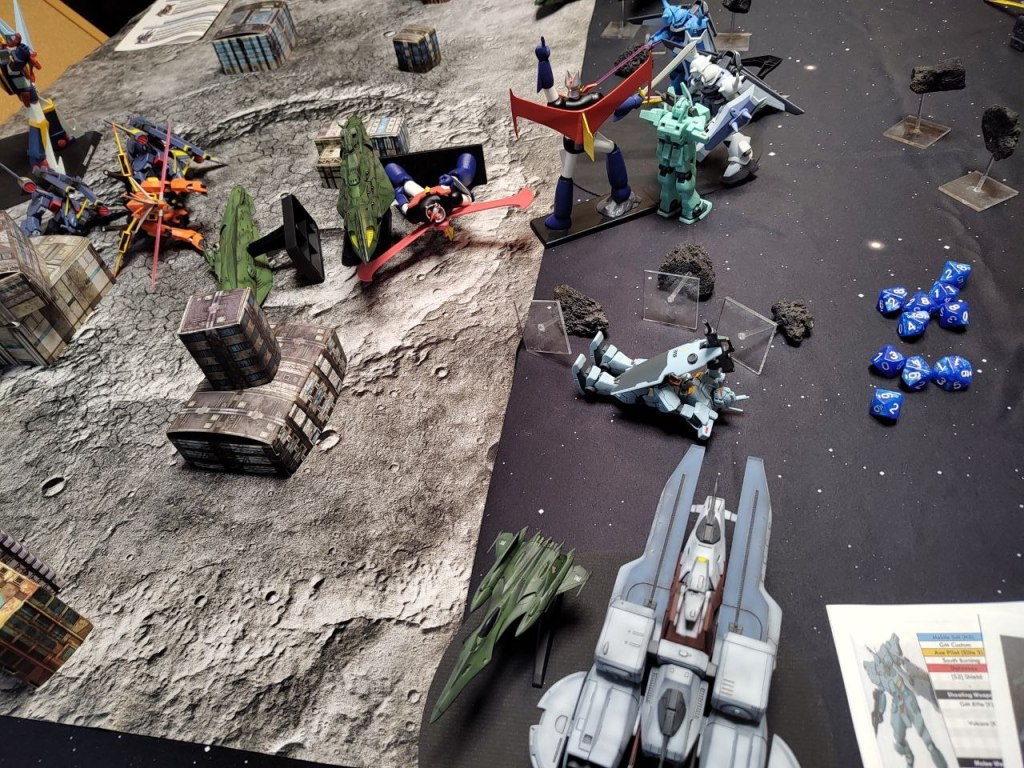
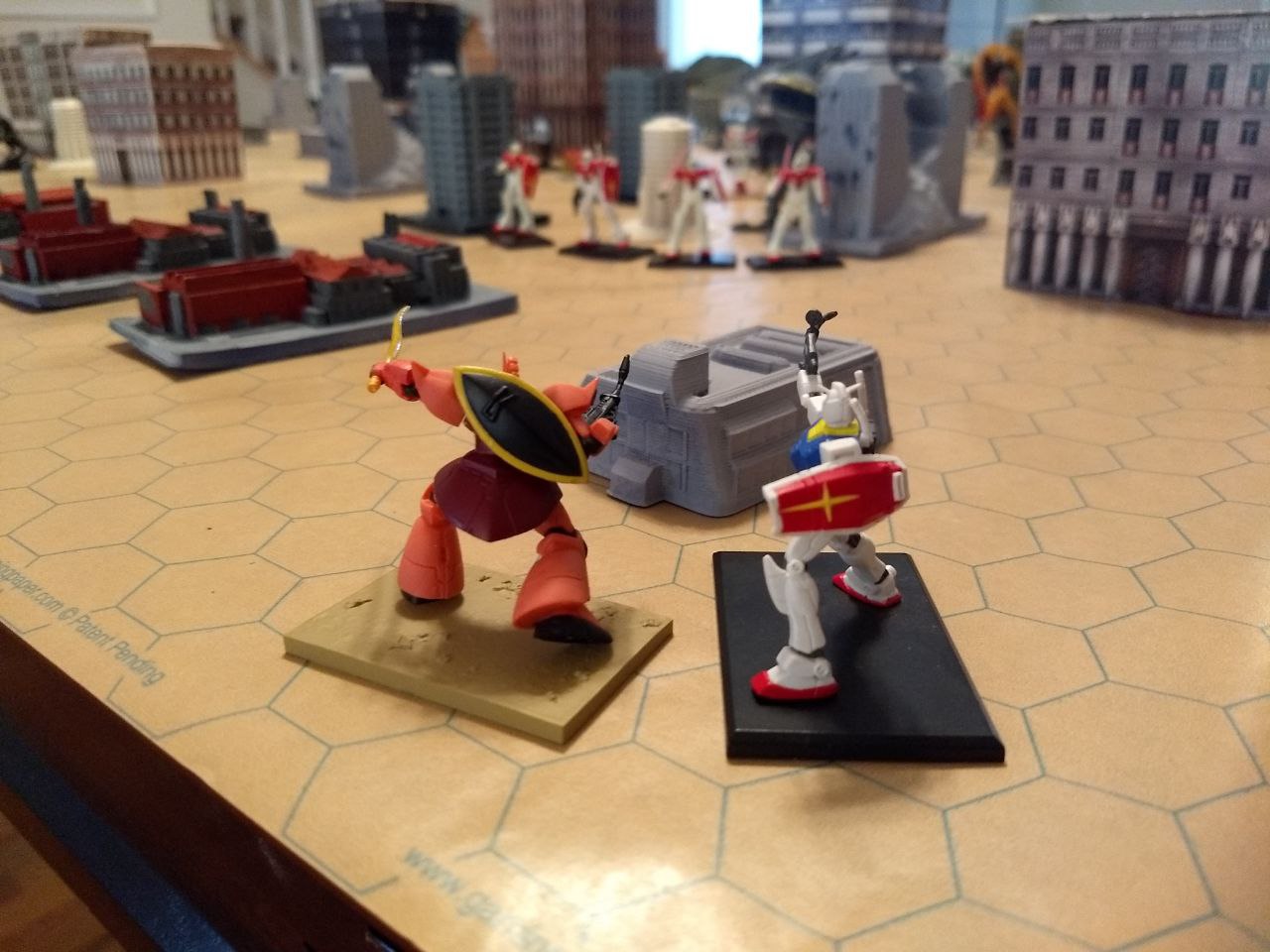
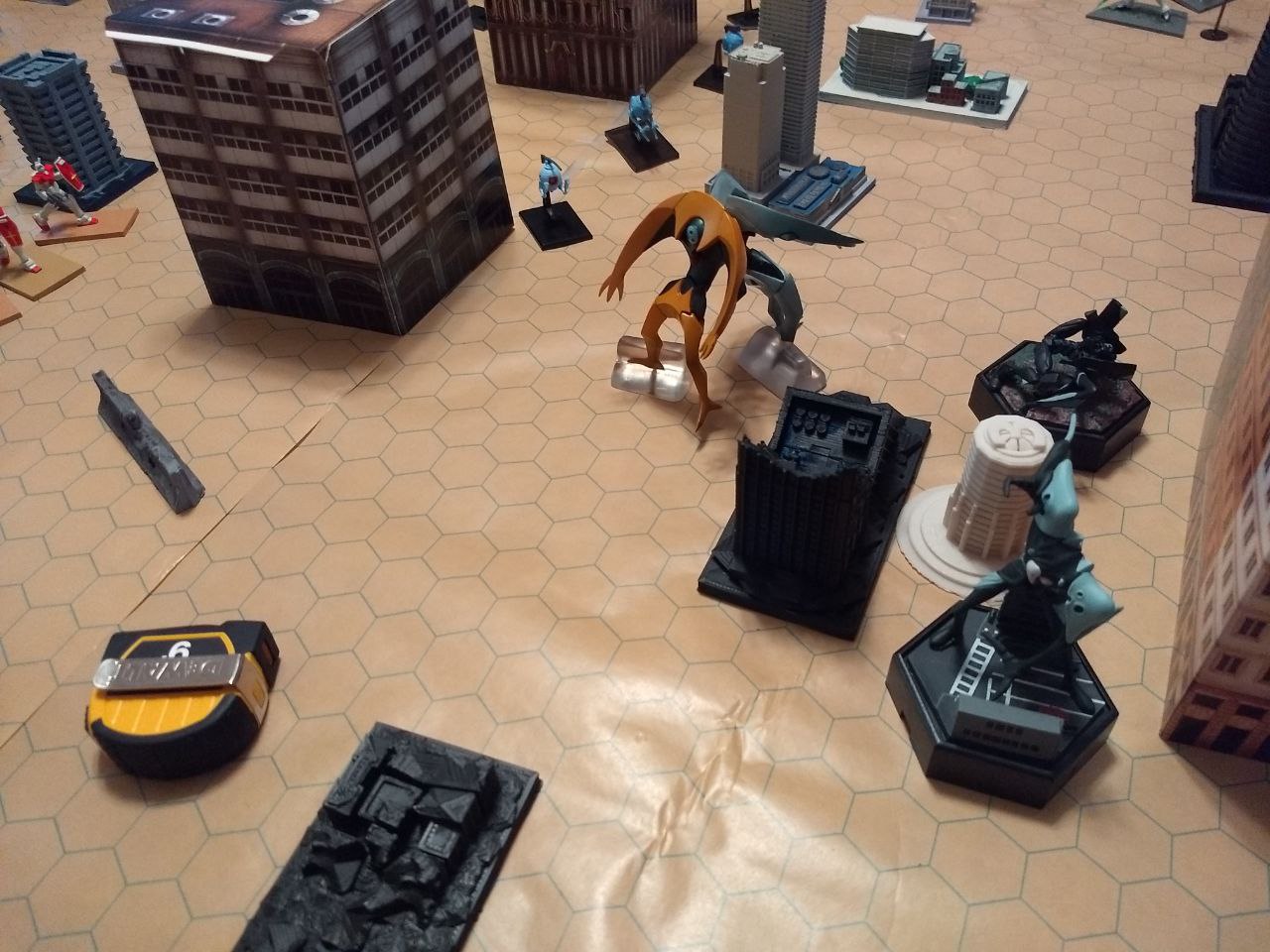
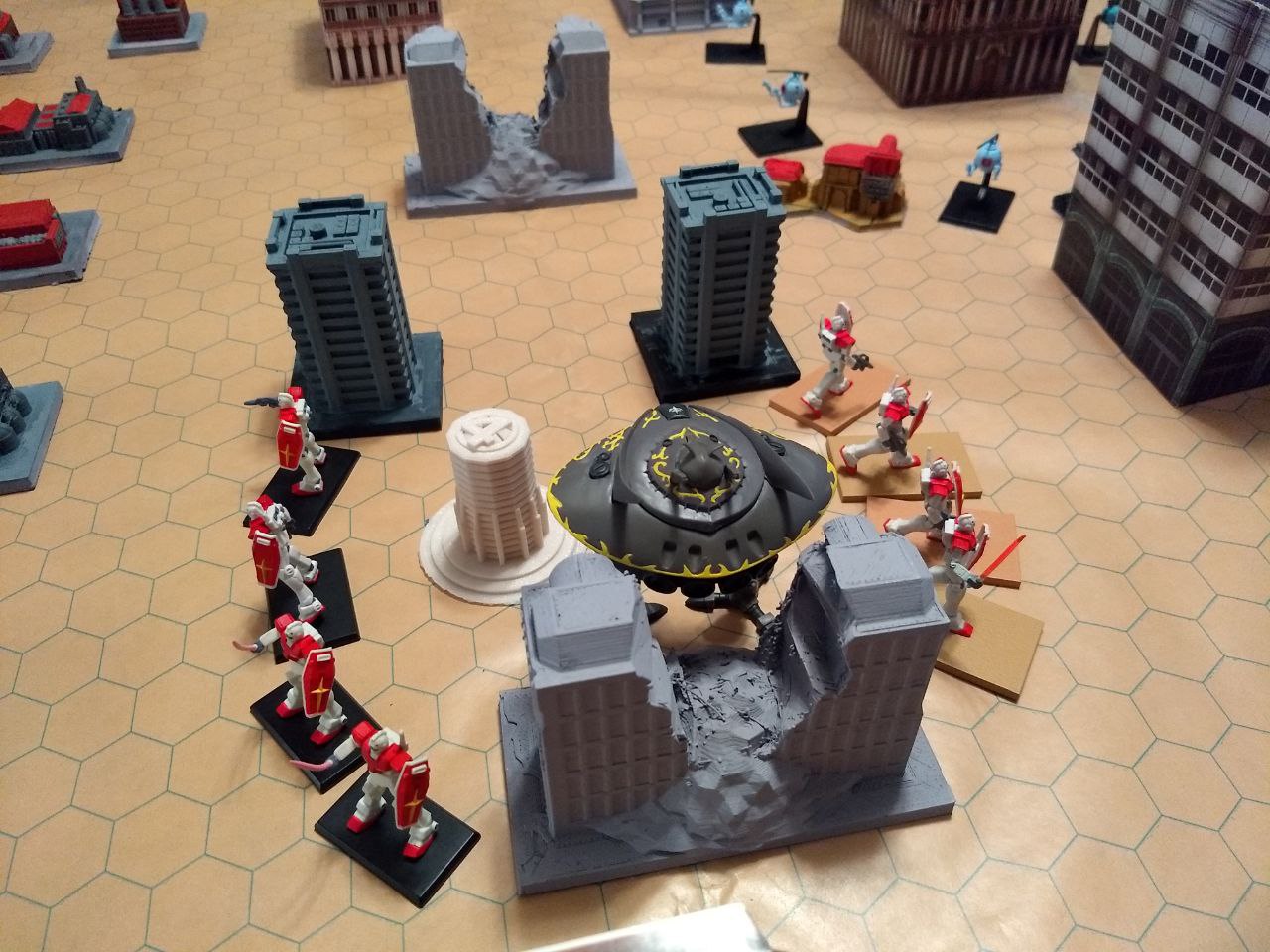
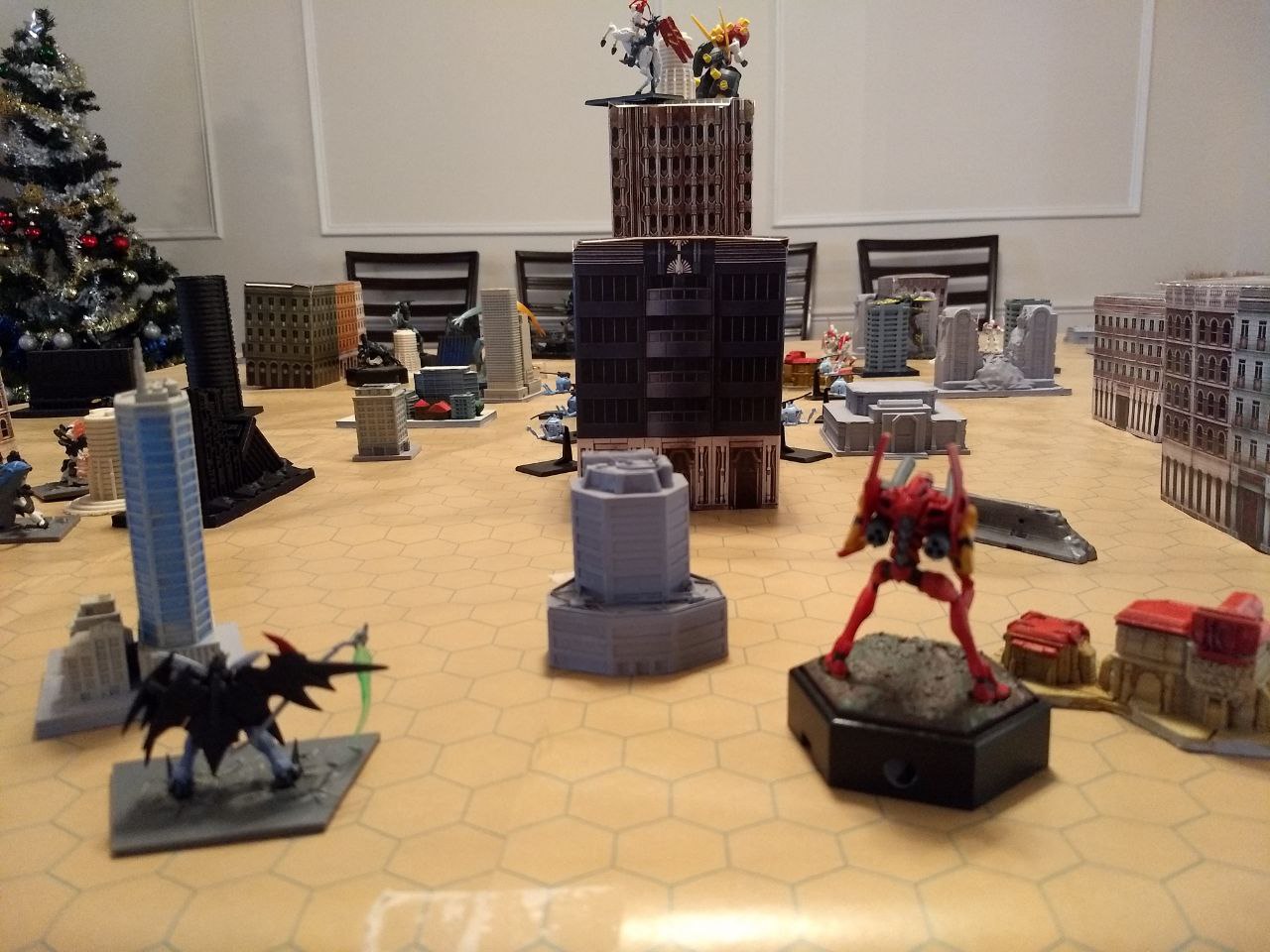
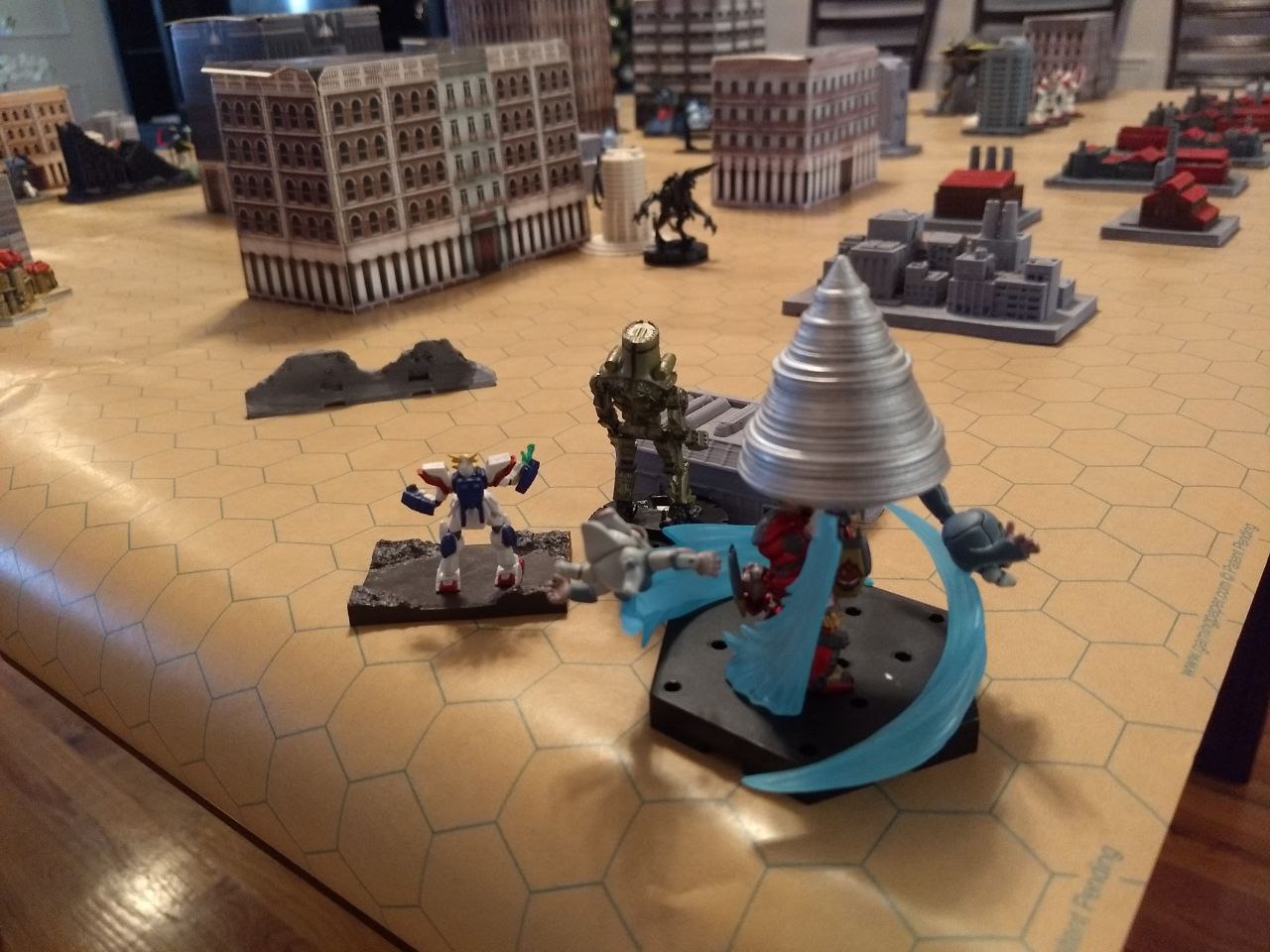
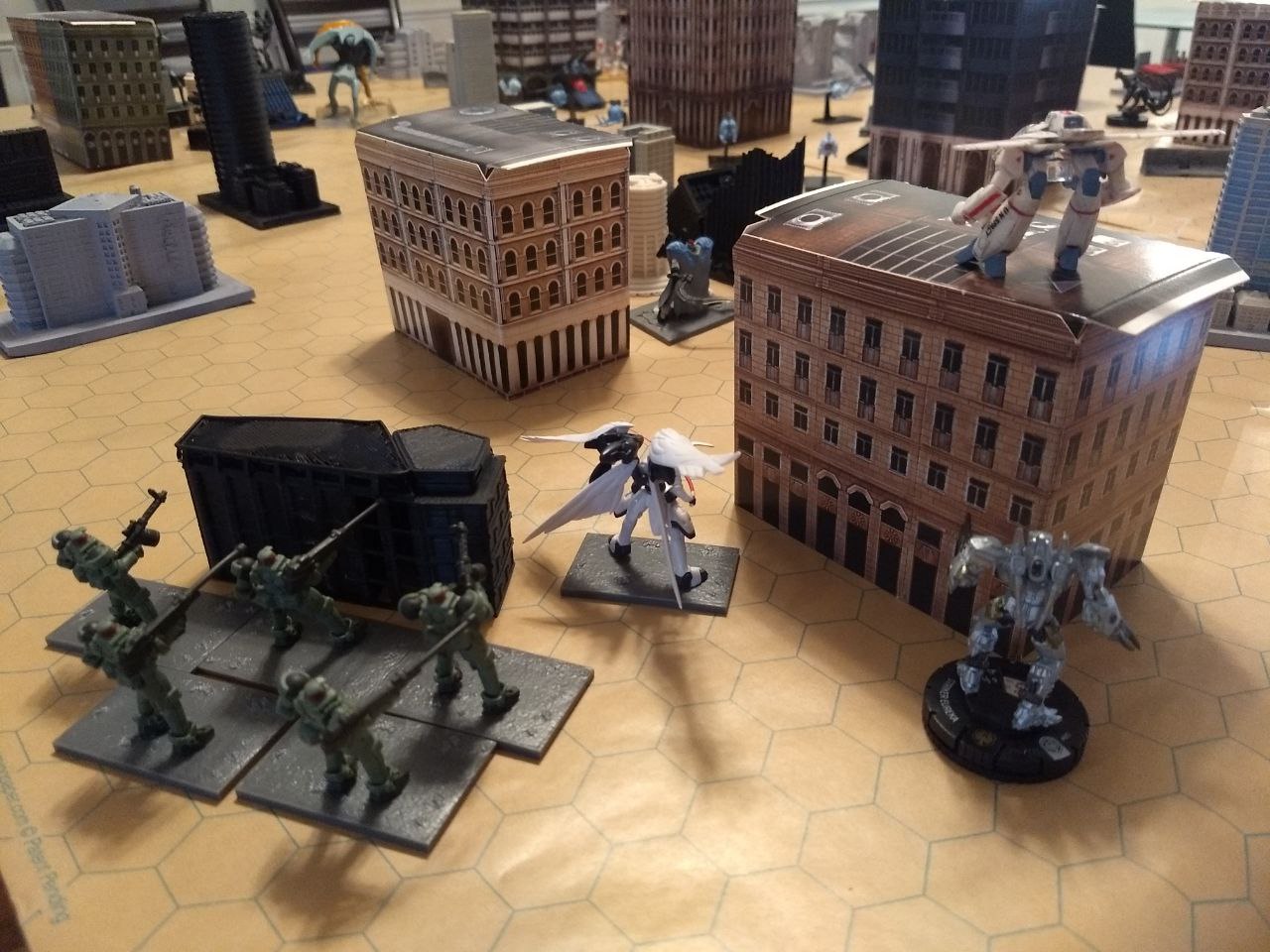
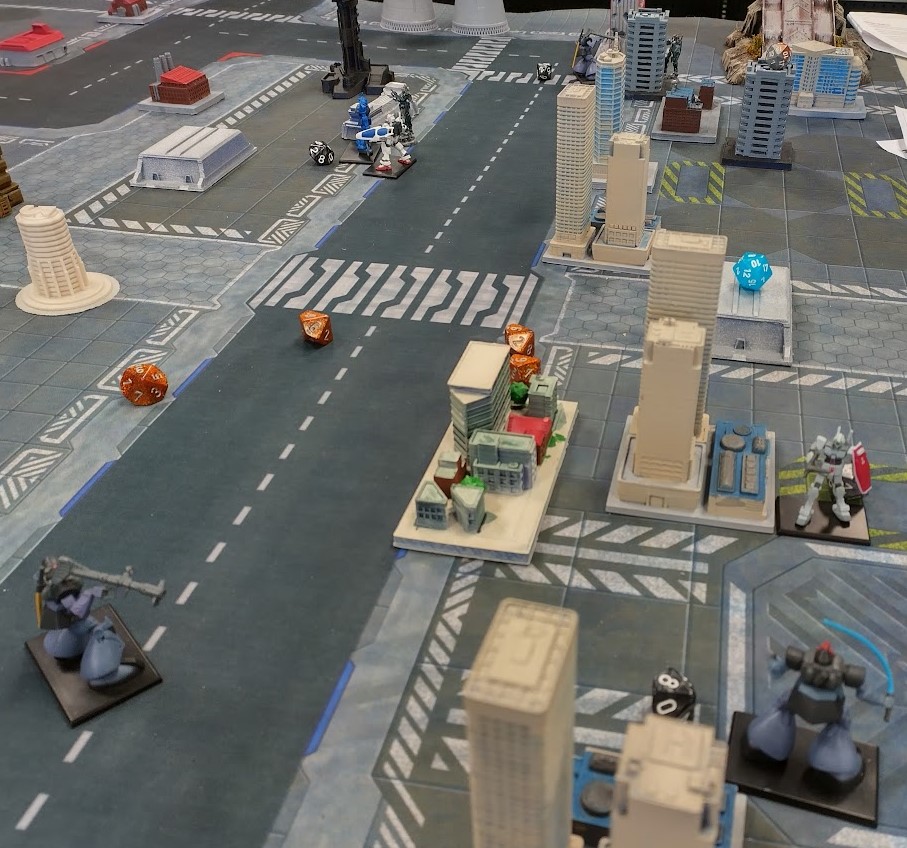
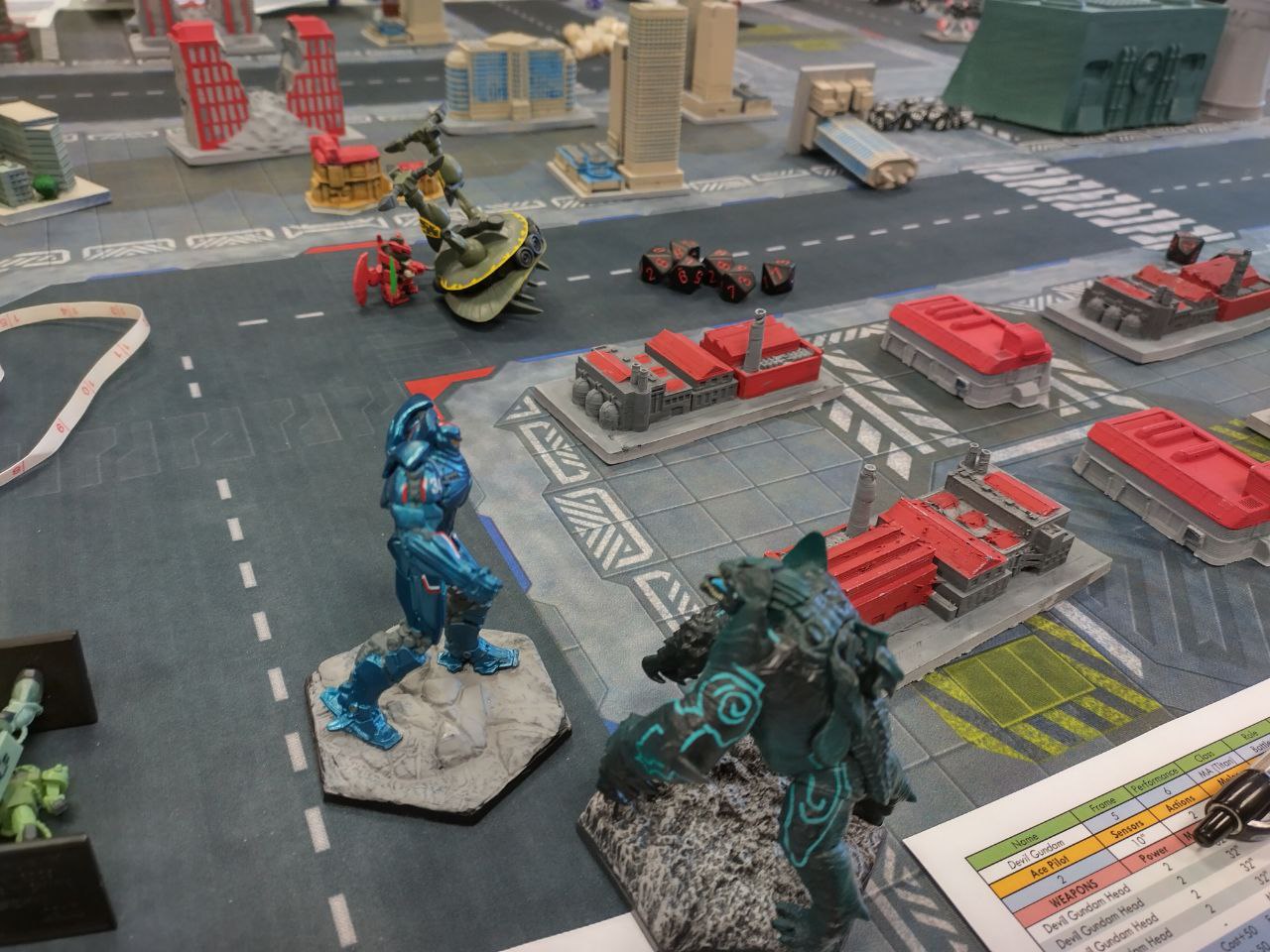
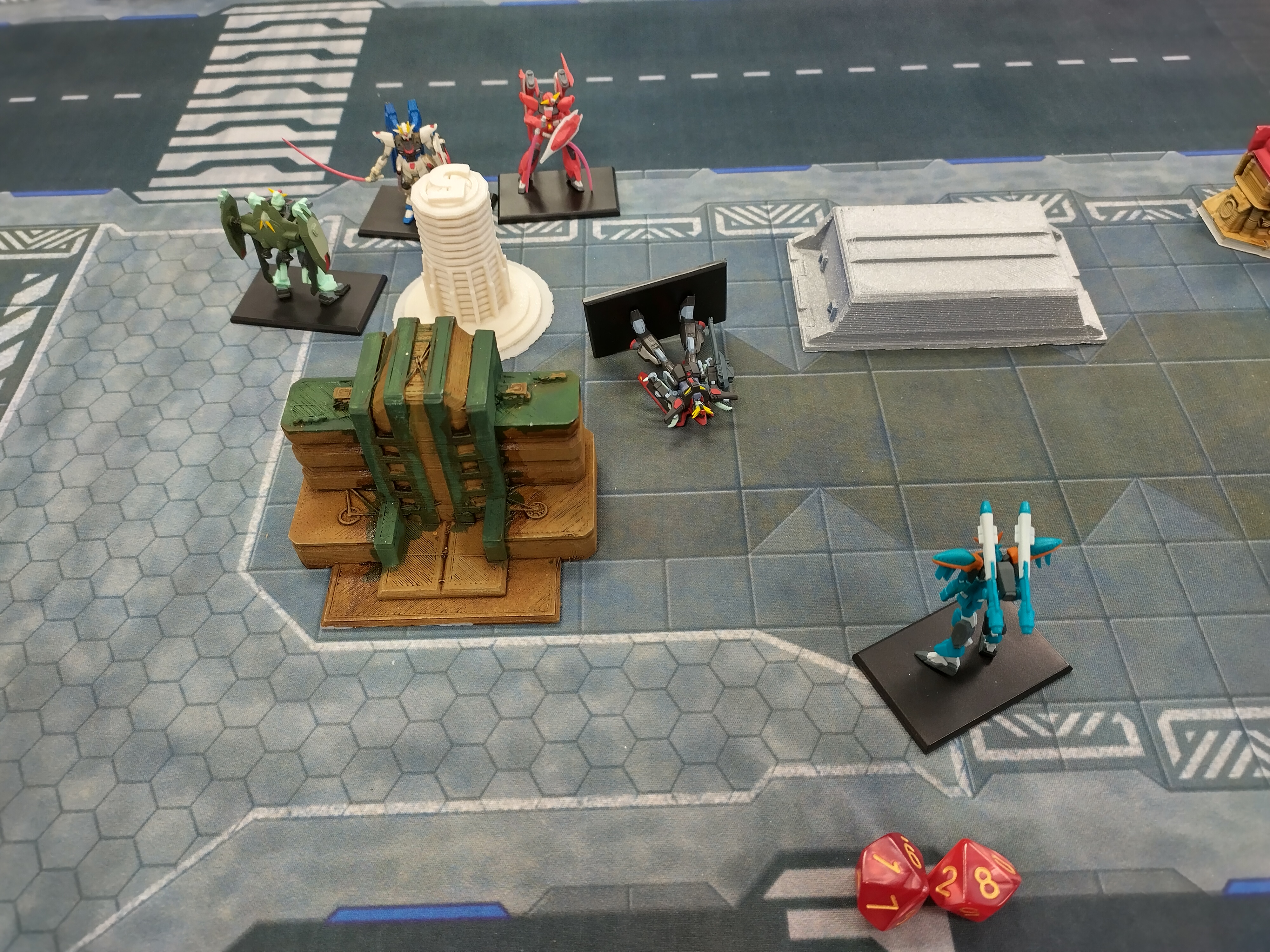
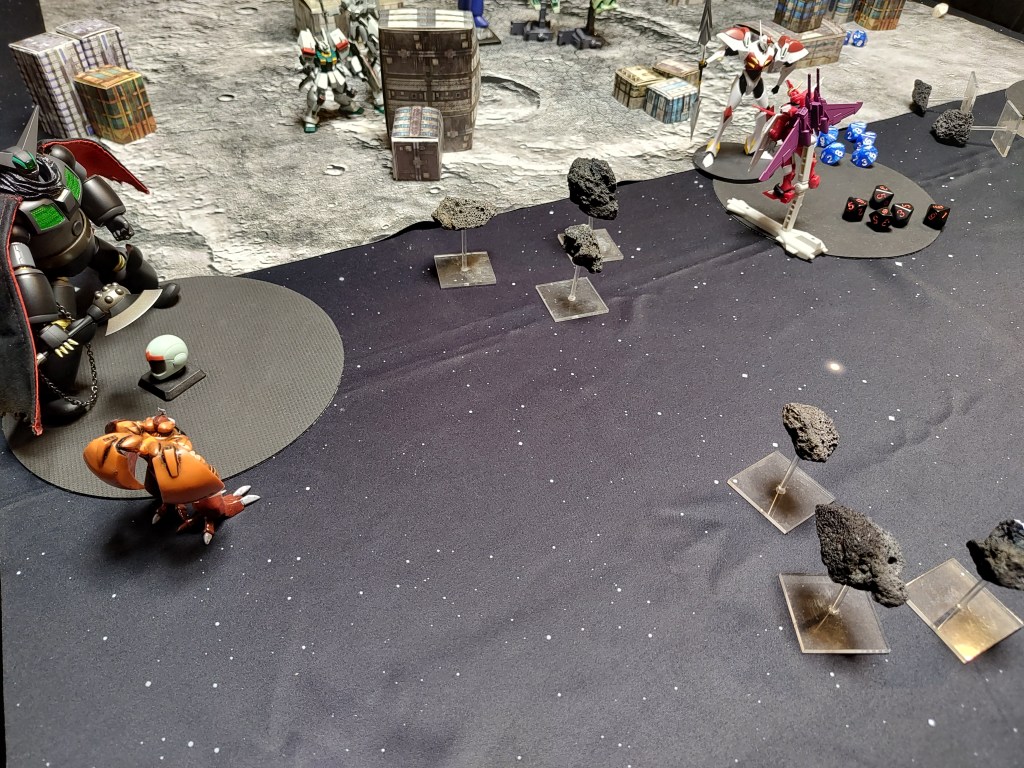
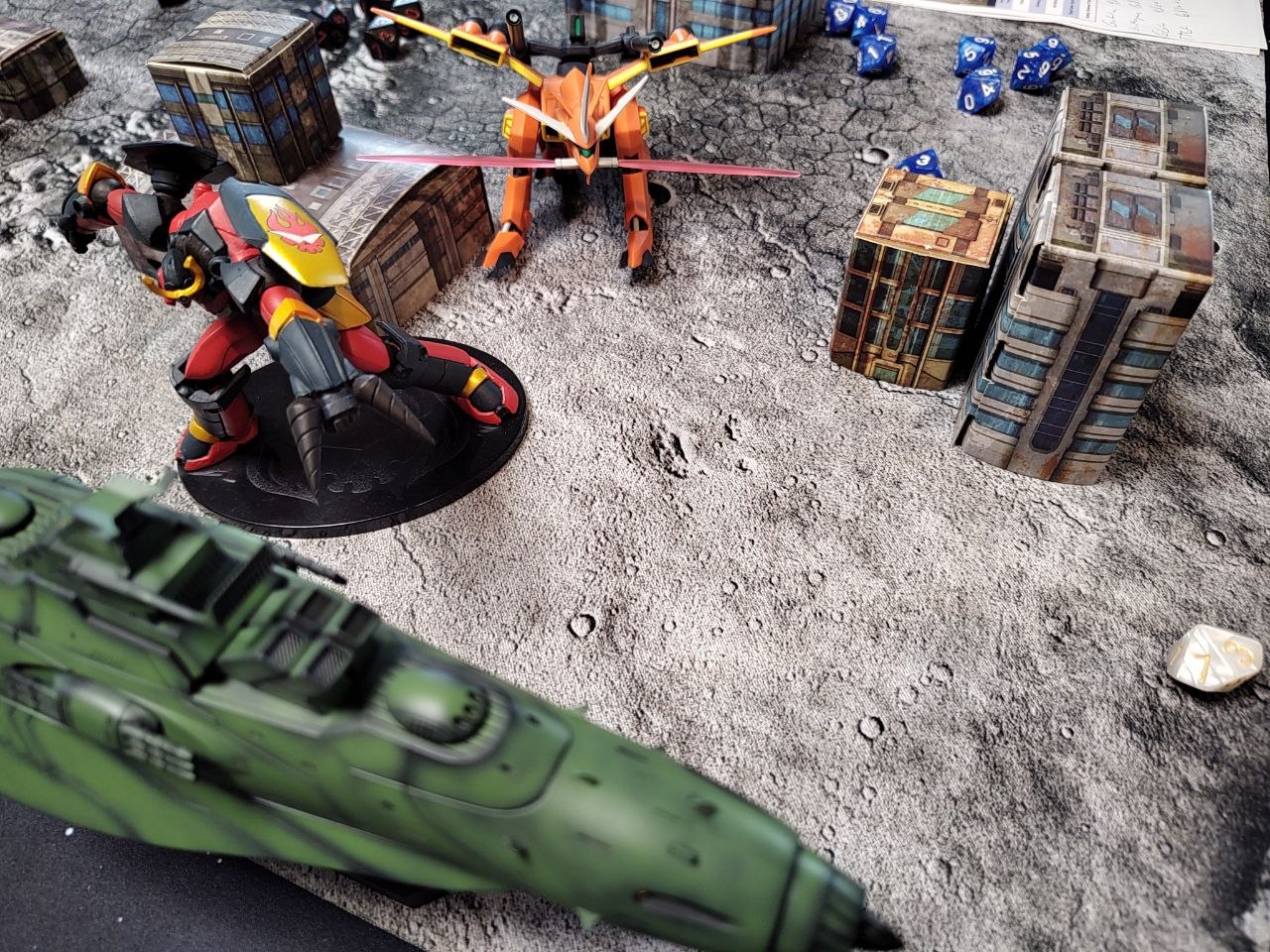
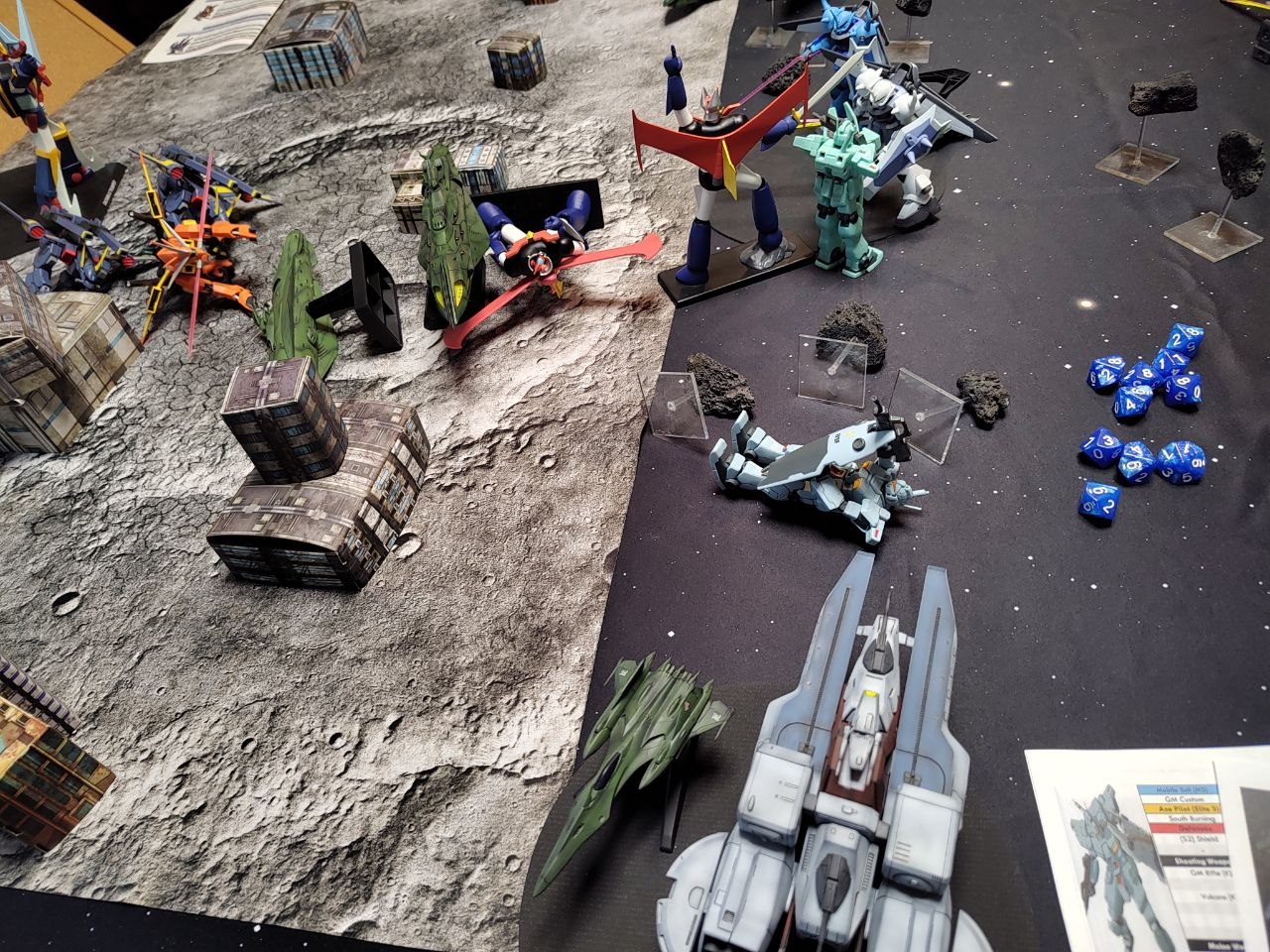
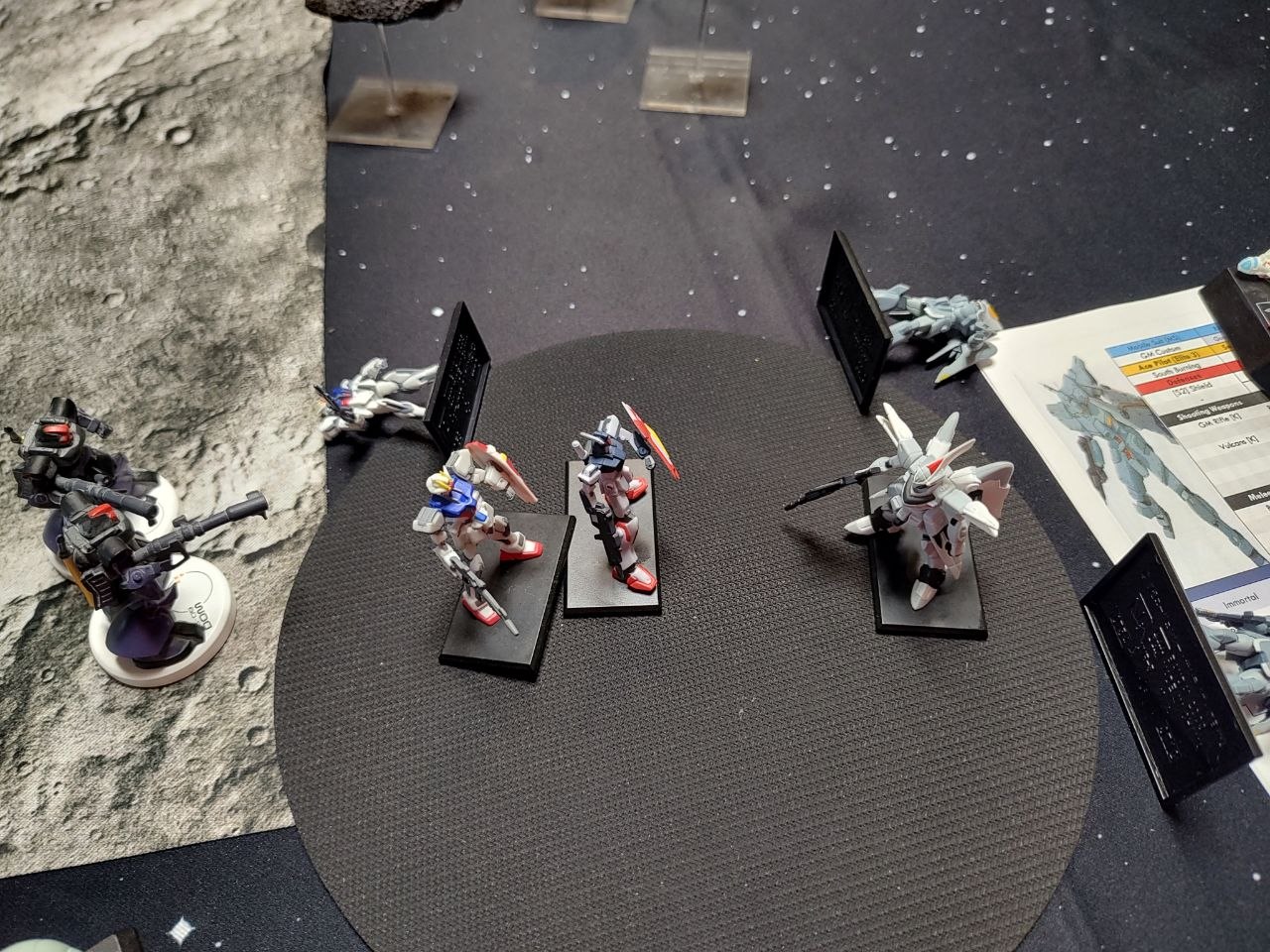
Hello everyone, we are going to postpone July’s update while we continue to finalize the core rules and mech profiles for MechaStellar VER11 currently targeting for August release. In this post we’re sharing some recent playtest photos for MechaStellar VER11.
We’ve had some major improvements on Squads, Warships, Momentum Generation and Lethality. In the most recent Gundam focused playtest we had only 50% casualties in a grunt game at Round 5. We think you’ll enjoy VER11 which will be a more streamlined form of VER10, with units surviving longer, better integrated morale & mechanics, weapons each embracing a specific battlefield role, and a more strategic feel to spending Momentum.
In the meantime we will continue doing VER11 Profile Previews once or twice a week.
And we plan on doing about 10 or so Design Goals posts leading up to the VER11 release in August. Stay tuned!
May’s update is a light one. Based on playtester feedback we are busy working on a balance patch, an update to Finishing Blow and a major core rules overhaul that will streamline a number of items to cut down on the amount of decision making on each turn or combat action. This will be a very big update for the game and we are hoping it will make overall gameplay much, much faster; turning a 1 hour game into a 40 minute game. Look forward to June!









 MechaStellar